Performance estimation analyzes the time and computational resources required to execute an algorithm on a specified architecture. For quantum programs, simulator run time is only a misleading first approximation: results vary with implementation language, simulator design, and allocated qubits. section 9.3
Compare quantum solutions by separating algorithmic behavior from execution-environment effects:
- Full-state simulators are strongly influenced by the number of allocated qubits. section 9.3
- Sparse simulators depend primarily on the number of basis states manipulated. section 9.3
- Simulator timing does not directly predict quantum-computer timing, because classical simulators perform additional state-maintenance work. section 9.3
- Physical-qubit noise, limited and slow gates, error correction, and logical-gate implementation affect run time and qubit requirements. section 9.3
N queens implementations
Two N queens solutions reverse their apparent ranking across simulators: Qiskit takes over two minutes for one hundred runs of the first algorithm and under a second for the second, while Q# takes 16 and 20 seconds respectively. section 9.3
Table 9.1 Simulation times for different solutions to the N queens puzzle
| Algorithm | Qiskit run time | Q# run time |
| Section 8.2 | 137 sec | 16 sec |
| Section 8.3 | < 1 sec | 20 sec |
Use the timing table to compare the same N queens algorithms across Qiskit and Q# simulators. section 9.3
Figure 9.5 Physical qubits are noisy, they support a limited set of gates, and these gates are slow. We have to use error correction to enable reliable computation on noisy qubits. We also have to use a special process to implement arbitrary logical gates on logical qubits. These factors affect both the run time of algorithms on the quantum computers and the numbers of qubits required to run them.
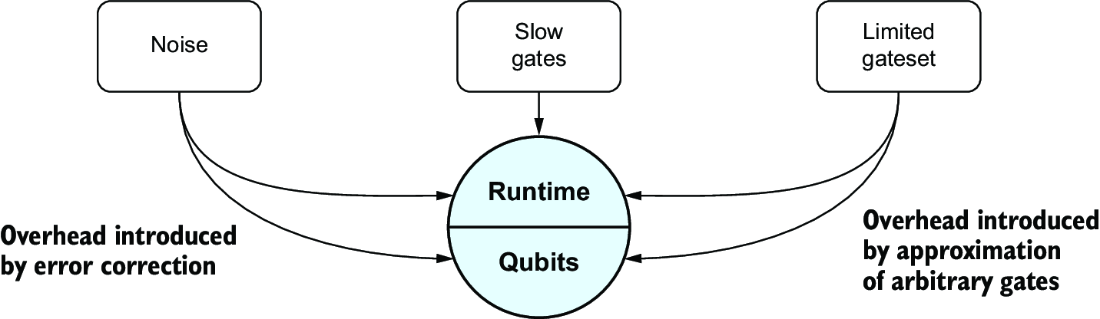
Use the hardware diagram to inspect how noisy physical qubits, error correction, and logical gates change resource estimates. section 9.3
