liveBook · Manning

Period

As explained in Acing the CCNA Exam: Volume 2 Advanced Networking and Security

A period is the time required for one complete oscillation of a periodic wave.

Period is the time required for one complete oscillation of a periodic wave. It describes how long each cycle takes, while frequency describes the number of oscillations per second and is measured in hertz (Hz). section 18.2.1

Calculating a cycle duration

A wave with a frequency of 4 Hz completes four oscillations each second. Each oscillation therefore takes 0.25 seconds: its period is 0.25 seconds. section 18.2.1 section 18.5

Figure 18.7 A wave with a frequency of 4 Hz. This means it completes four full oscillations every second, resulting in a period of 0.25 seconds per oscillation.
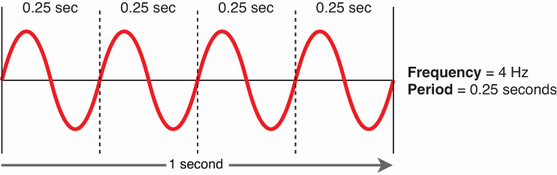
Use the wave diagram to relate four oscillations per second to a 0.25-second period for each oscillation. section 18.2.1


How Acing the CCNA Exam: Volume 2 Advanced Networking and Security covers it

How deep it goes
Defines one complete oscillation and provides a 4 Hz worked example, without developing further mathematical treatment.
Examples
Uses a 4 Hz wave that completes each oscillation in 0.25 seconds.
What it assumes
Builds from the ideas of waves, oscillation, and frequency while defining period directly.
What you can do after
Evaluate a wave’s cycle duration when its frequency and oscillation rate are given.
How it connects
Connects period with frequency, oscillation, amplitude, electromagnetic waves, and radio frequency.

Also explained in

Compare how 2 books explain period →

Related concepts

This explainer was generated by Manning's knowledge graph from the text of Acing the CCNA Exam: Volume 2 Advanced Networking and Security. The section links point to the parts of the book it draws on.