A permutation matrix is a square binary matrix with exactly one 1 in every row and column. As a quantum operation, it represents a reversible classical computation: each input bit string maps to exactly one output bit string, and vice versa. section 3.0
Recognize a permutation matrix by these properties:
- Contains only 0 and 1 entries. section 3.0
- Contains exactly one 1 in each row and each column. section 3.0
- Can often be implemented more efficiently by analyzing the corresponding classical computation. section 3.0
Figure 3.1 Any quantum algorithm can be broken down into several steps: prepare the initial state, evolve it by applying unitary transformations, and measure the final state. In this chapter, we’ll learn to perform the second step: implementing unitary transformations as the algorithm dictates.
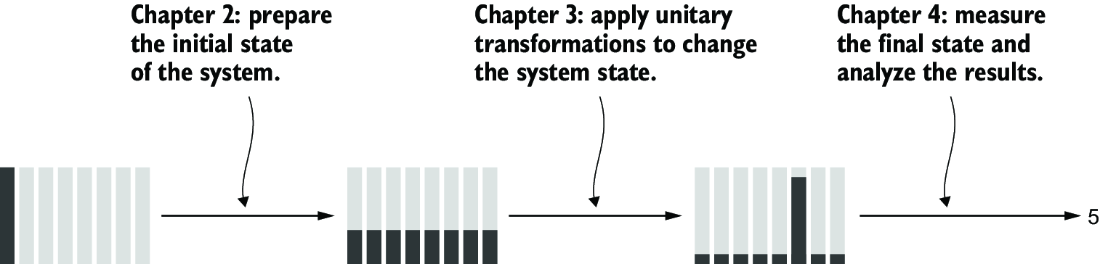
Places permutation-matrix operations within the broader quantum-algorithm flow: prepare a state, apply unitary transformations, and measure. section 3.0