A permutation problem searches for an ordered arrangement of a specified set of elements. With n variables, each candidate is a list of n distinct integers, each appearing exactly once, so order and adjacency remain explicit. section 8.3
This model fits problems where sequence matters, including ride-sharing scheduling with limited vehicles and drivers, and adjacency-based routing such as the traveling salesman problem (TSP). section 8.3
An eight-city tour
A candidate TSP solution can be written as [1, 2, 3, 4, 5, 6, 7, 8] or [2, 4, 6, 1, 5, 3, 8, 7]. Each city appears once, while changing the order changes the tour and its adjacency relationships. section 8.3 section 9.4
Optimization methods must preserve valid permutations while exploring alternatives:
- Genetic algorithms use specialized crossover and mutation operators so cities or events are not duplicated or omitted. section 8.3
- Particle swarm optimization replaces ordinary arithmetic with swap-based operations: velocity becomes a sequence of swaps, subtraction derives swaps between positions, and addition applies them. section 9.4
- Simulated annealing treats TSP as a discrete optimization problem and adapts its trajectory-based search to that setting. section 5.0
Figure 9.8 Redefined multiplication for permutation-based PSO
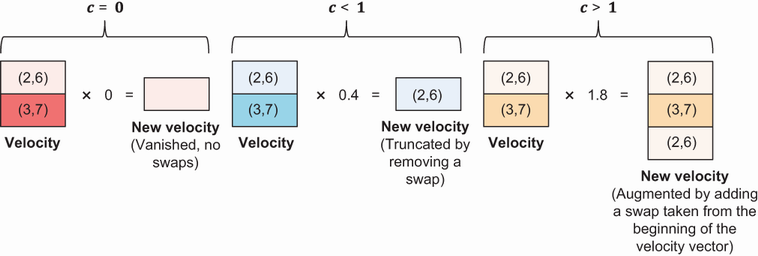
Visualizes how scaling a swap sequence changes the effective PSO velocity. section 9.4
