A platform consolidation can receive a disciplined review and still produce a fragile decision. If the discussion stays focused on architectural integrity, the team may approve lower operating costs without examining lost customer flexibility or new commercial friction. The reasoning is coherent; its frame is too narrow. section 5.1
Perspective rotation, also called chair-of-thought, holds the problem fixed while a group reasons from different optimization frames in turn. A chair is a temporary viewpoint, not the person or function assigned to defend it. A customer, finance, or regulatory pass can reveal constraints that another pass could not see. The point is not to satisfy every chair equally, but to make tensions visible before choosing which trade-offs to accept. section 5.0 section 5.5
Use rotation when the disagreement may be about priorities rather than faulty logic:
- Different stakeholders optimize for materially different outcomes, or disagreement persists after assumptions and alternatives are clear. section 5.4.1
- The decision has long-term or cross-functional effects, or ethical, security, reputational, or regulatory concerns are not receiving attention. section 5.4 section 5.4.2
- Unexpected emotional intensity suggests that an important constraint is being marginalized. Ask, “Which chair are we currently reasoning from?” and “Which chair would disagree most strongly?” section 5.4.2
Keep the intervention small and sequential:
- State one narrow decision problem. Choose a few chairs that optimize for genuinely different outcomes; three to five are usually sufficient. section 5.5 section 5.4.2
- Spend a short pass in each chair. Record its risks, constraints, and opportunities without comparing or dismissing them yet. section 5.5
- Compare the recorded views, identify unavoidable tensions, and decide which concerns to prioritize or partially deprioritize. section 5.5
Revisit a platform consolidation
Keep the proposed consolidation unchanged for each pass. The architectural chair sees reduced overhead and greater stability. The customer chair asks what becomes fragile when the platform is standardized, including enterprise flexibility and integration pathways. The commercial chair then examines sales and revenue implications. These passes need not overturn the proposal; they turn potential downstream surprises into explicit trade-offs. section 5.6.2 section 5.1
Do not add chairs to a local, tightly bounded decision governed by one constraint. In a difficult discussion, introduce rotation as an additional check, not a challenge to expertise: “Can we look at this from a different seat for a minute?” Treat each chair as a pass rather than a position to defend. Strong hierarchy, low psychological safety, or too many lenses can turn the exercise into symbolic coverage instead of a real shift in attention. section 5.4 section 5.6.1 section 5.6.2 section 5.7
Figure 5.2 Chair-of-Thought separates exploration from evaluation by rotating through perspectives sequentially, capturing each view before comparison begins, so trade-offs are surfaced explicitly rather than collapsed into early consensus.
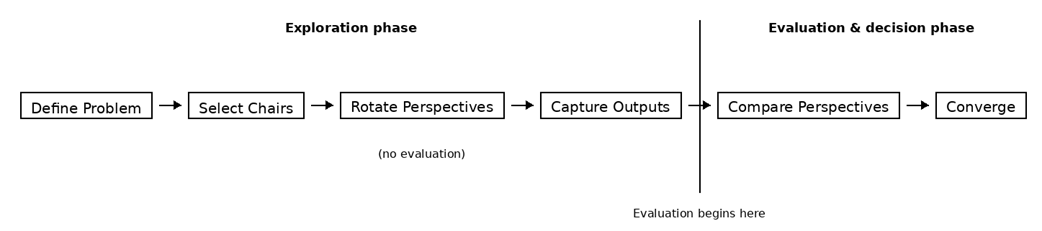
The diagram separates sequential perspective exploration from later comparison, helping prevent an early return to the dominant frame. section 5.5