pgvector is a PostgreSQL extension that adds vector storage, similarity-search operators, and specialized indexes. It turns PostgreSQL into a vector database for recommendation services, semantic search, clustering, and retrieval-augmented generation. section 8.0 section 8.2
A practical pgvector workflow includes:
- Start PostgreSQL with a pgvector-enabled image, such as pgvector/pgvector:0.8.0-pg17. section 8.2
- Enable the extension with CREATE EXTENSION vector; after connecting to PostgreSQL. section 8.2
- Store embeddings and compare them with cosine distance (<=>), Euclidean distance (<->), or inner product (<#>). section 8.4
- Optimize searches with IVFFlat or HNSW indexes, balancing search performance, recall, and index size. section 8.7
Enable pgvector in Docker and PostgreSQL
Create a persistent volume and start the database: `docker volume create postgres-pgvector-volume` followed by `docker run --name postgres-pgvector -e POSTGRES_USER=postgres -e POSTGRES_PASSWORD=password -p 5432:5432 -v postgres-pgvector-volume:/var/lib/postgresql/data -d pgvector/pgvector:0.8.0-pg17`. Connect with `docker exec -it postgres-pgvector psql -U postgres`, then run `CREATE EXTENSION vector;`. Querying available extensions afterward shows vector version 0.8.0 installed. section 8.2
Figure 8.6 Performing vector similarity search with Postgres
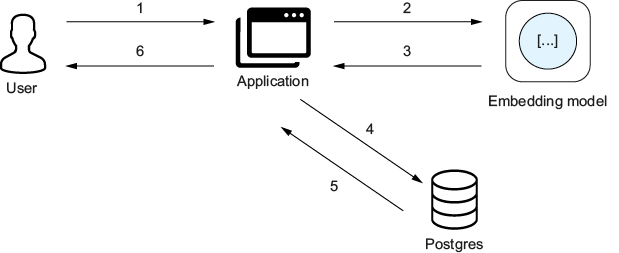
Use the workflow diagram to follow embedding generation, PostgreSQL storage, vector comparison, and recommendation results. section 8.4
