Pharmacokinetics (PK) describes what the body does to an administered drug: absorbing, distributing, metabolizing, and excreting it. It is contrasted with pharmacodynamics, which concerns what the drug does to the body. section 1.4.2
PK follows the candidate through four linked processes:
- Absorption moves a drug from its administration site—such as the gastrointestinal tract or respiratory system—into the bloodstream. section 1.4.2
- Distribution describes movement through the body after bloodstream entry. section 1.4.2
- Metabolism uses biochemical transformation, primarily by enzymes, to produce more polar and water-soluble metabolites. section 1.4.2
- Excretion removes the drug and its metabolites from the body. section 1.4.2
PK is assessed during ADMET screening and lead optimization because poor absorption or overly rapid clearance can eliminate an otherwise promising candidate and increase clinical-trial failure risk. section 1.4.2 section 1.1.1
Figure 1.12 We can break down the ADMET properties into the following broad descriptions. Absorption refers to the process by which a drug enters the bloodstream from its administration site, such as the gastrointestinal tract for oral drugs or the respiratory system for inhalation drugs. Distribution pertains to the movement of a drug within the body once it has entered the bloodstream. Metabolism refers to the biochemical transformation of a drug within the body, primarily carried out by enzymes. Metabolic processes aim to convert drugs into more polar and water-soluble metabolites, facilitating their elimination from the body. Excretion involves the removal of drugs and their metabolites from the body. Toxicity assessment aims to evaluate the potential adverse effects of a drug candidate on various organs, tissues, or systems.
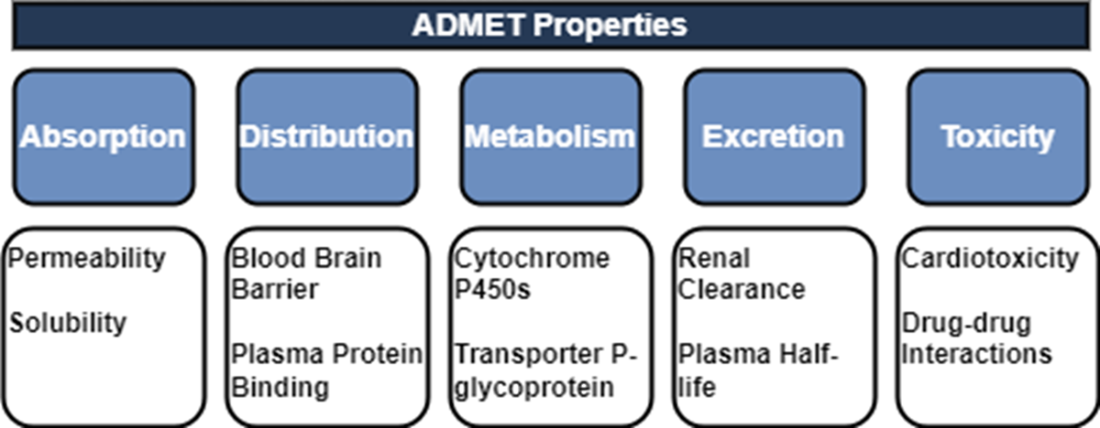
Use the ADMET breakdown to trace how absorption, distribution, metabolism, and excretion fit alongside toxicity assessment. section 1.4.2
