Pharmacophore-based screening selects compounds whose spatial arrangements and chemical features match a binding hypothesis. It is useful when several active compounds are known, or when structural information about a target binding site supports a pharmacophore hypothesis. section 2.1.1 section 9.2.4
A ligand-based pharmacophore search typically proceeds by:
- Generating possible three-dimensional configurations for known active compounds. section 2.1.1
- Aligning configurations to identify structural features shared by the active compounds. section 2.1.1
- Scoring features according to how commonly they occur. section 2.1.1
- Screening unknown compounds for high-scoring feature matches. section 2.1.1
The method belongs to ligand-based virtual screening when the target’s three-dimensional structure is unavailable. With target binding-site information, pharmacophore hypotheses can instead guide the initial sample for docking or active-learning workflows. section 2.1.1 section 9.2.4
Figure 2.1 Virtual screening pipelines are often hierarchical, proceeding with a broad, large number of compounds through simpler, less restrictive, and computationally cheaper processes to whittle down the quantity of compounds. If the 3D structure of the target is not defined, we’re restricted to ligand-based virtual screening. If it is defined, then we can explore structure-based virtual screening, potentially as a downstream component to ligand-based virtual screening.
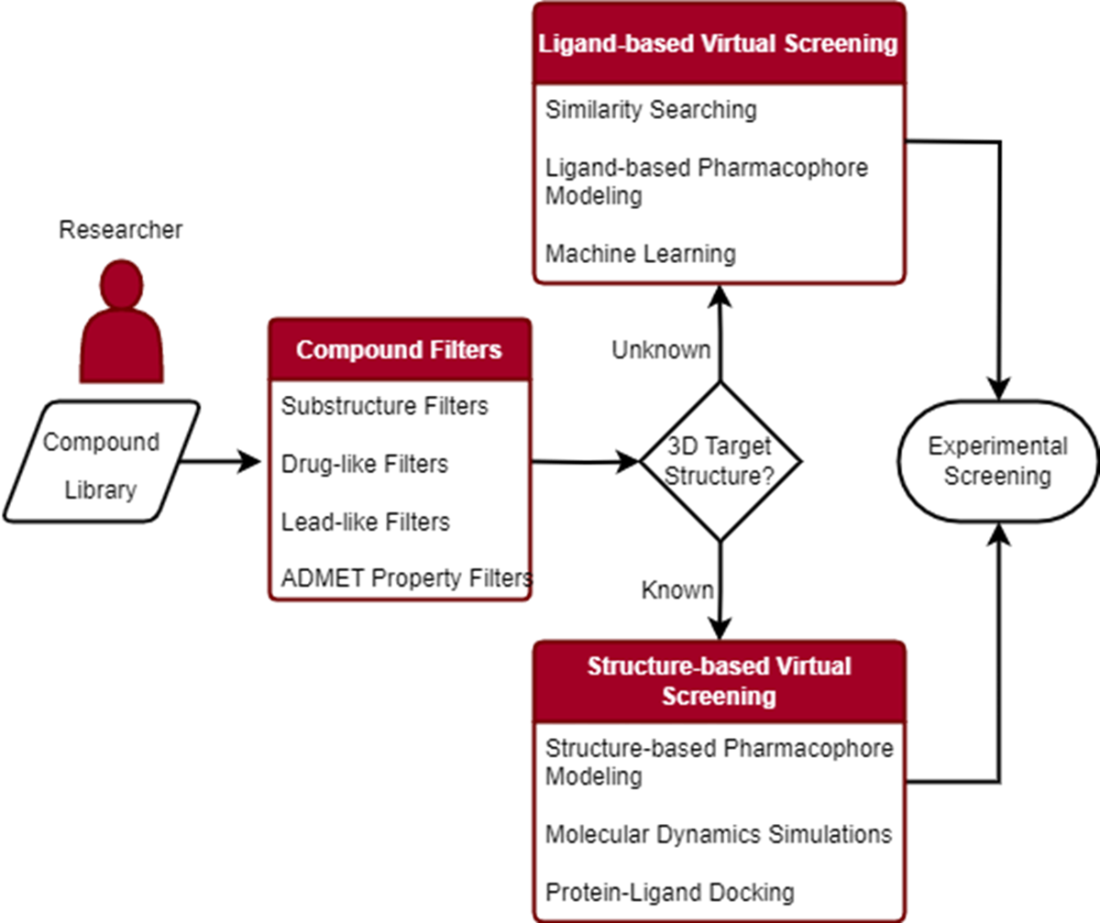
Use the virtual-screening pipeline diagram to place pharmacophore filtering among hierarchical screening stages that progressively reduce a compound library. section 2.1.1
