Phase encoding represents information in the relative phases of complex amplitudes rather than in their absolute values. Quantum Fourier transforms convert between phase encoding and amplitude encoding. section 5.5 section 5.3.4
Quantum phase estimation uses phase encoding as an intermediate representation:
- Prepare multiple control qubits in equal-amplitude superpositions. section 5.3.5
- Use controlled operations and phase kickback to encode different parts of an eigenphase in the control qubits’ relative phases. section 5.3.5
- Apply the inverse quantum Fourier transform to convert phase information into amplitudes. section 5.5 section 5.3.5
- Measure the control register and interpret the most probable basis state as a binary approximation of the eigenphase. section 5.3.5
Two-bit quantum phase estimation
For two bits of precision, use two control qubits in the |+⟩ ⊗ |+⟩ state. Controlled operations encode the eigenphase into their relative phases; inverse QFT concentrates amplitude on the basis state representing the best binary approximation, which measurement can reveal. section 5.3.5
Figure 5.8 In quantum phase estimation algorithm, we use multiple control qubits to encode the information about the eigenphase in phases of their states. Then, we use inverse quantum Fourier transform to convert that information from phase encoding to amplitude encoding, increasing the amplitude of the basis state that encodes the eigenphase compared to the amplitudes of other states. Finally, we measure the control qubits, reading out the bits of the phase as measurement results with high probability.
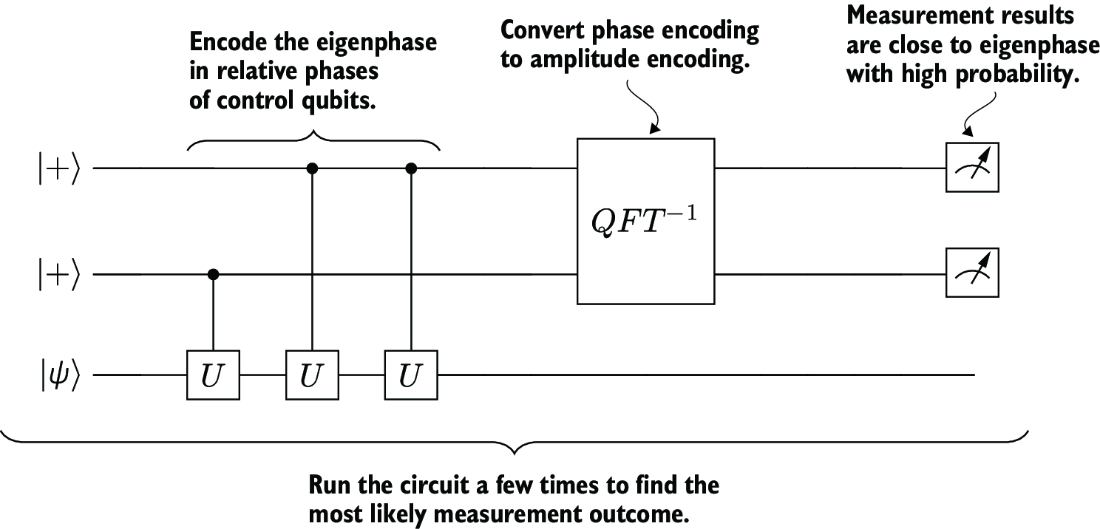
Trace the encoding pipeline from relative phases through inverse QFT to amplified measurement probabilities for the eigenphase bits. section 5.3.5
