A phenotypic feature is an observable physical or biochemical characteristic. An individual's phenotype is the sum of the features manifested with a disease; features can also be modeled as diseases, depending on context. section 3.0 section 3.1.1
Use phenotypic features as structured, traceable links between clinical observations and diseases:
- Represent each standardized feature as an ontology concept with an identifier, label, synonyms, description, and hierarchy. section 3.1.2
- Connect diseases to features through annotated relationships that preserve evidence, source references, onset, frequency, sex, modifiers, and curation metadata. section 3.1.2 section 3.3.2
- Query direct matches or traverse subclass relationships to retrieve diseases associated with specific or broader phenotype categories. section 3.4 section 3.5
Type 1 diabetes as a context-dependent feature
Type 1 diabetes mellitus uses HP:0100651 when represented as a phenotypic feature and OMIM:222100 when represented as a disease. Querying additional features such as growth delay, large knee, sensorineural hearing impairment, and pruritus can surface candidate rare diseases, including Ondontochondrodysplasia 2 with hearing loss and diabetes. section 3.1.1 section 3.4
Figure 3.4 Type 1 diabetes mellitus can be considered either a disease or a phenotypic feature. Based on the context, two different IDs can be adopted.
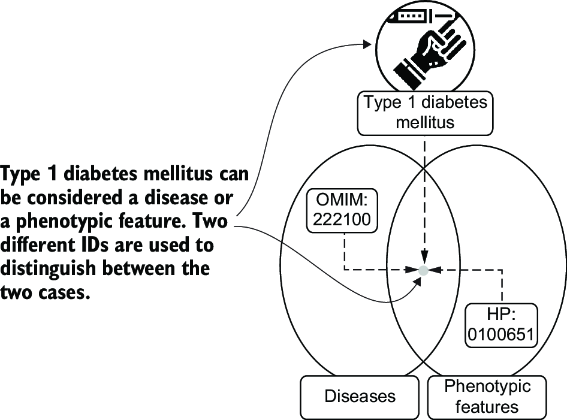
Shows why the same clinical concept can require different identifiers when modeled as a disease or as a phenotypic feature. section 3.1.1
