liveBook · Manning

Pheromone deposit

As explained in Optimization Algorithms: AI techniques for design, planning, and control problems

Pheromone deposit is the addition of simulated pheromone to paths or edges traversed by artificial ants.

Pheromone deposit adds simulated pheromone to paths or edges traversed by artificial ants, increasing the likelihood that later ants choose those edges. section 10.2

Common deposit strategies differ in when pheromone is added and how its amount is calculated:

  • Online step-by-step updates deposit pheromone as each ant traverses an edge; ant density uses a constant amount, while ant quantity scales deposits with local edge quality such as Q/dij. section 10.2
  • Online delayed updates, also called the ant cycle model, wait until an ant completes its solution, then reinforce the traversed path according to solution quality. section 10.2
  • Deposit interacts with evaporation: no evaporation can trap ants in a local optimum, whereas maximum evaporation forces random exploration and can slow convergence. section 10.2
Figure 10.5 Pheromone update methods
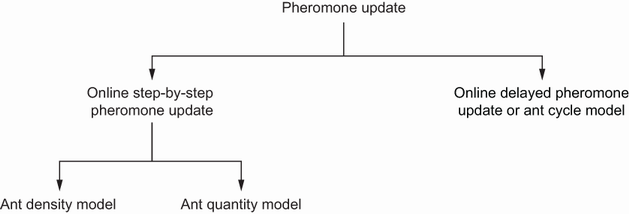
Compare the pheromone update methods used to reinforce ant-traversed paths. section 10.2

How Optimization Algorithms: AI techniques for design, planning, and control problems covers it

How deep it goes
Distinguishes stepwise, density-based, quantity-based, and delayed updates, while stopping short of complete parameter formulas.
Examples
Illustrates deposit through the NetLogo Ants model and a figure comparing pheromone update methods.
What you can do after
Evaluate deposit strategies by comparing reinforcement timing, traffic-based amounts, edge quality, and evaporation effects.
How it connects
Connects pheromone deposit with ant colony optimization, pheromone evaporation, exploration, exploitation, and local optima.

Related concepts

This explainer was generated by Manning's knowledge graph from the text of Optimization Algorithms: AI techniques for design, planning, and control problems. The section links point to the parts of the book it draws on.