A photographic negative holds an image before it becomes a paper print. In the film, areas converted to silver become black in the final photograph, while unconverted areas become white. Enlarging the negative onto positive paper can introduce gray through an analogue process; at sufficient enlargement, film grain becomes visible. section 8.2
A negative can contain gray tones, but a newspaper printing plate may permit only black and white. Halftoning bridges that gap: it converts gray into regularly spaced dots whose diameters vary with the level of gray. Wide, separated dots make the result reproducible even on cheap, porous newsprint. section 8.2
Figure 8.15 Our gradient and its halftone
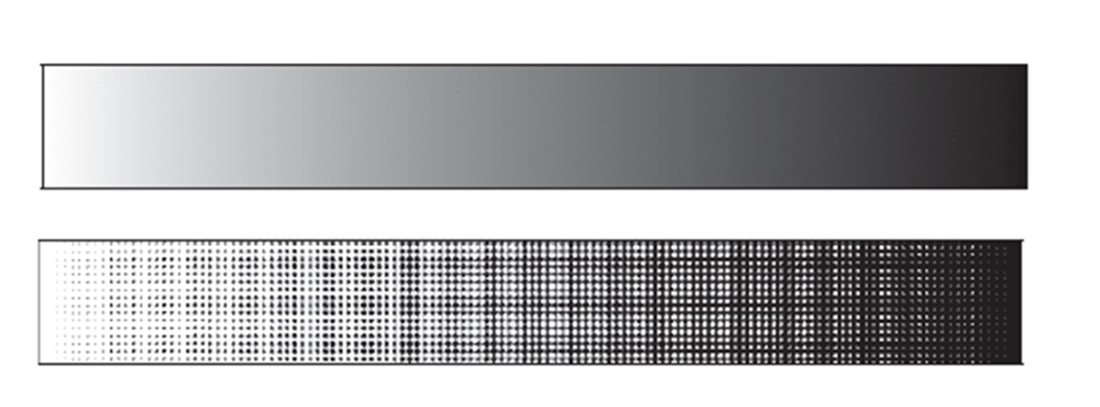
Compare a continuous gradient with its halftone: tonal variation becomes a pattern of distinct black dots sized to suggest gray. section 8.2
Early halftones used a screen placed before photographic paper while the original image was projected through a lens. Cloth-gauze screens appeared around 1850; later glass screens carried engraved grids. Optical effects formed varying dots on the paper, yielding a black-and-white starting point for printing plates. section 8.2
