Photon-based quantum computing is one of the main hardware approaches pursued worldwide, alongside superconducting circuits, trapped ions, and neutral atoms. Its development is judged against milestones from proof-of-concept devices to fault-tolerant systems and practical quantum advantage. section 1.3.2
Figure 1.2 The major milestones of quantum hardware development. The first two, showing the use of quantum mechanics to perform a computation and having a quantum computer solve an artificial problem that a classical computer cannot, have already been achieved. The next milestone, building a fault-tolerant quantum computer that can run long computations, is the current focus. The final goal is to build a quantum computer that can solve practical problems that a classical computer cannot.
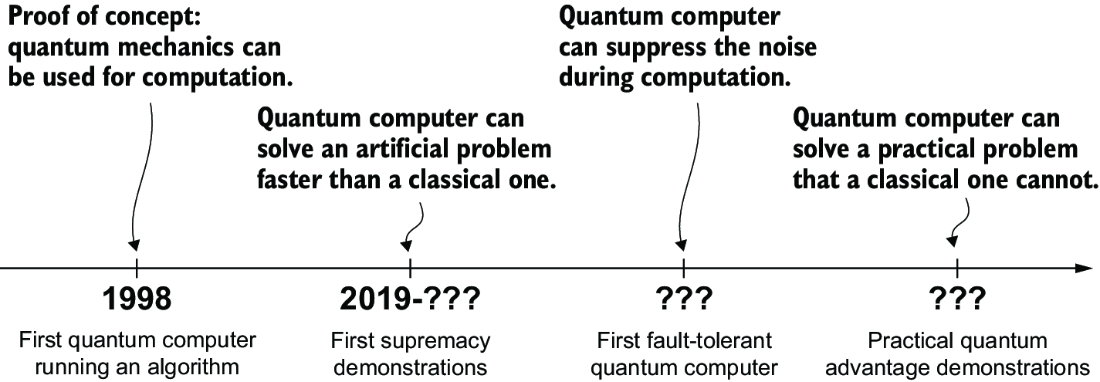
Maps the hardware milestones relevant to assessing photon-based quantum-computing platforms, from fundamental demonstrations through fault tolerance and practical problems. section 1.3.2
