Physical time is time measured by clocks and used to describe when events occur and how long they take. Distributed systems use it alongside logical time, but physical time is inherently uncertain across components. section 2.0 section 2.2.3
A synchronous system assumes synchronized clocks or a known maximum deviation, plus strict timing or bounded delays. An asynchronous system provides no such timing guarantee, so a missing message may indicate failure or delay. section 2.0 section 2.1.2
Physical clocks create several practical concerns:
- Clock skew is a difference in the time readings of two clocks; the clocks may retain a fixed offset. section 2.2.3
- Clock drift is a difference in ticking frequency; clocks that initially agree can gradually diverge. section 2.2.3
- Network Time Protocol mitigates skew and drift by having a server broadcast its reading while clients adjust their clocks. section 2.2.3
- A hypothetical wall clock provides a perfect global reference, but components must use imperfect local physical clocks. section 2.2.3
Two clocks, one event
Suppose Clock 1 and Clock 2 begin five minutes apart and preserve that offset: this illustrates skew. If they begin together but slowly separate, this illustrates drift. Comparing their timestamps therefore requires explicit timing assumptions or synchronization. section 2.2.3
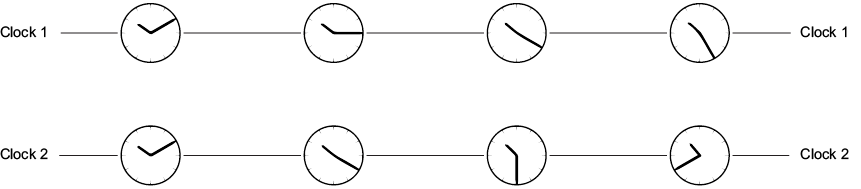
Use the clock-skew figure to see how two physical clocks preserve a fixed time difference. section 2.2.3
