Pipeline orchestration coordinates the execution, ordering, and status of automated pipeline stages. It serves as foundational platform infrastructure, helping developers build, release, and operate applications without manually coordinating every delivery dependency. section 6.0 section 6.2
Without an orchestrated platform, developers may spend substantial time arranging DNS entries, firewall rules, storage, compute capacity, monitors, alerts, and pipeline changes with other teams. Orchestration addresses this coordination burden as part of an incremental, self-service engineering platform. section 6.0
A platform foundation places the pipeline orchestrator alongside:
- Source code version control for managing delivery inputs. section 6.2
- A secrets store for protected configuration and credentials. section 6.2
- An infrastructure state store for tracking infrastructure automation state. section 6.2
Epetech platform scenario
An internal engineering platform uses pipeline orchestration to reduce the coordination work surrounding API services, giving developers a more self-service path from design and build through release and operation. section 6.0
Figure 6.1 We want to create an internal product that provides a genuinely self-service experience where developers can imagine, design, build, release, and operate their applications with agility, high engineering quality, greater operational resiliency, and confidence in meeting compliance requirements, yet without all the engineering friction they usually experience. In other words, we are creating an engineering platform.
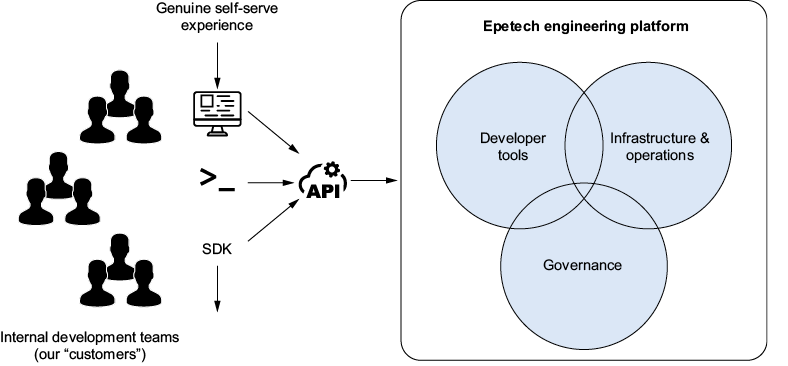
Shows pipeline orchestration as one capability within an internal product intended to provide agility, engineering quality, operational resilience, and compliance confidence. section 6.0
