liveBook · Manning

Placeholder

As explained in Prompt Engineering in Practice

A placeholder is a symbolic position in a template reserved for a value that changes between uses.

A placeholder marks a changing input in a reusable prompt. Replace named placeholders with concrete values before inference to vary the input while preserving the prompt’s core logic. section 2.9 section 5.0

Use placeholders to make prompts reusable and their outputs more consistent:

  • Name each variable clearly, such as {{feature_name}} or {{constraints}}. section 5.0
  • Keep stable background information in the prompt; use placeholders for values that change between uses. section 2.9 section 5.0
  • Test varied input combinations before using the template in real work. section 5.0

Incident summary

A repeatable incident summary can include a [Root Cause] placeholder alongside resolution and action-item fields, keeping each summary’s structure consistent. section 4.4.1

Figure 5.1 Prompt template runtime flow
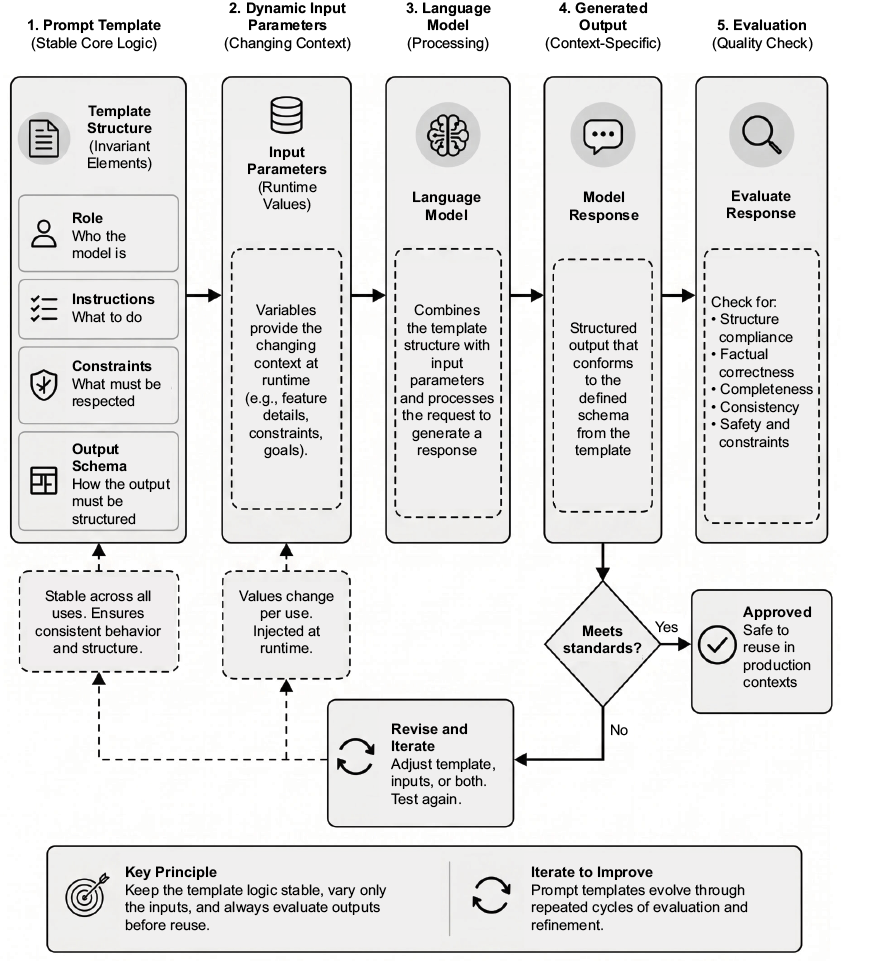
Shows the runtime flow from stable template logic and changing input parameters to evaluation of the generated response. section 5.0


How Prompt Engineering in Practice covers it

How deep it goes
Explains named variables, value substitution before inference, and testing across input combinations.
Examples
Uses {{feature_name}}, {{constraints}}, and [Root Cause] as examples of changing prompt values.
What it assumes
Builds on structural prompt elements, linguistic elements, and prompt patterns.
What you can do after
Build reusable prompts by substituting named values and testing varied input combinations before use.
How it connects
Connects placeholders to prompt templates, input parameters, context, constraints, and output formats.

Also explained in

Compare how 7 books explain placeholder →

Related concepts

This explainer was generated by Manning's knowledge graph from the text of Prompt Engineering in Practice. The section links point to the parts of the book it draws on.




