A platform-level failure is a failure whose lowest layer capable of detecting and mitigating it correctly is the platform layer. In a layered system, that layer might be an operating system beneath an application, or a database system beneath its own application. A CouldNotConnect result is platform-level because the platform can try to reestablish the connection; an application-level failure such as InsufficientFunds is meaningful only to the application. section 3.3.3
Figure 3.10 Application-level vs. platform-level failure
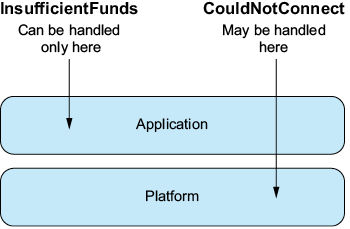
Use the layered comparison to locate a failure at the lowest layer that can interpret and mitigate it completely. section 3.3.3
Mitigate platform-level failures according to their temporal behavior:
- Retry immediately when the failure is transient and expected to repair itself. section 3.3.6
- Schedule multiple retries with backoff when the failure is intermittent and autorepairable. section 3.3.6
- Suspend the process, repair the underlying condition, and resume it when the failure is permanent and requires manual repair. section 3.3.6
- Elevate the failure to the application when platform mitigation ultimately fails. section 3.3.6
A failed connection attempt
An attempted credit-card charge returns CouldNotConnect. The platform identifies the connection failure and attempts recovery rather than interpreting the business meaning of the charge. A timeout can also witness complete unavailability, but in partially synchronous or asynchronous systems with unreliable networks, a missing message may reflect delay rather than a crash. section 3.3.4
