liveBook · Manning

Platform-provided service discovery

As explained in Microservices Patterns, Second Edition

Platform-provided service discovery is service discovery implemented by a deployment platform rather than by application code.

Platform-provided service discovery delegates locating service instances to the deployment platform, so most teams do not need to implement discovery in application code. section 8.2.5

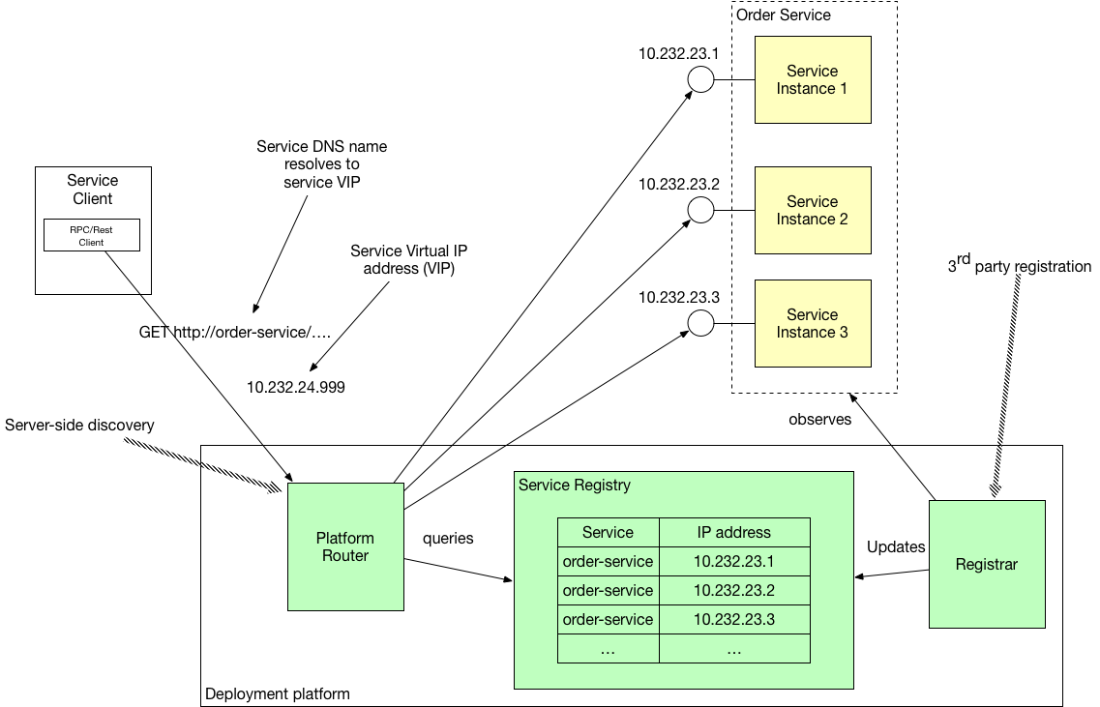
The platform registers service instances and routes client requests to available instances. Services can be addressed by a DNS name or virtual IP; a router queries the registry and balances requests. section 8.2.5

Figure 8.11 The platform is responsible for service registration, discovery, and request routing. Service instances are registered with the service registry by the registrar. Each service has a network location, a DNS name/virtual IP address. A client makes a request to the service’s network location. The router queries the service registry and load balances requests across the available service instances.
PlatformProvidedServiceDiscovery

Shows the platform’s registrar, service registry, network locations, and request router. section 8.2.5

How Microservices Patterns, Second Edition covers it

How deep it goes
Describes the registration and routing flow, including registry lookup and load balancing across available instances.
Examples
Uses dynamically assigned service addresses and DNS names or virtual IPs to illustrate discovery and routing.
What you can do after
Understand how a platform registers service instances and routes requests without application-managed discovery.
How it connects
Connects deployment-platform discovery to service registries and application-level service discovery.

Related concepts

This explainer was generated by Manning's knowledge graph from the text of Microservices Patterns, Second Edition. The section links point to the parts of the book it draws on.