A player is an individual who participates in an interactive game by taking turns, making choices, and performing game actions. In Bogart, two players alternate turns after one is randomly selected to start. section 10.4.1
A player’s turn combines automatic events and decisions. The player rolls an increasing number of dice, chooses whether to continue after safe rolls, collects the pot by stopping, or loses the turn’s chips after rolling a 1. section 10.4.1
A game implementation tracks the player through these responsibilities:
- Identify the current player and the other player. section 10.4.2
- Run a complete turn and determine whether the player collects chips, collects nothing, or wins immediately. section 10.4.2
- Transfer collected chips to the player, reset the pot, and switch turns only when the game has not ended. section 10.4.2
Player turn in Bogart
At the start of a turn, one chip enters the pot and the player rolls one die. Continuing adds two chips and requires two dice, then three, four, and five dice in sequence. A 1 ends the turn without a payout; stopping transfers the pot to the player. section 10.4.1
Figure 10.5 Player turn in Bogart
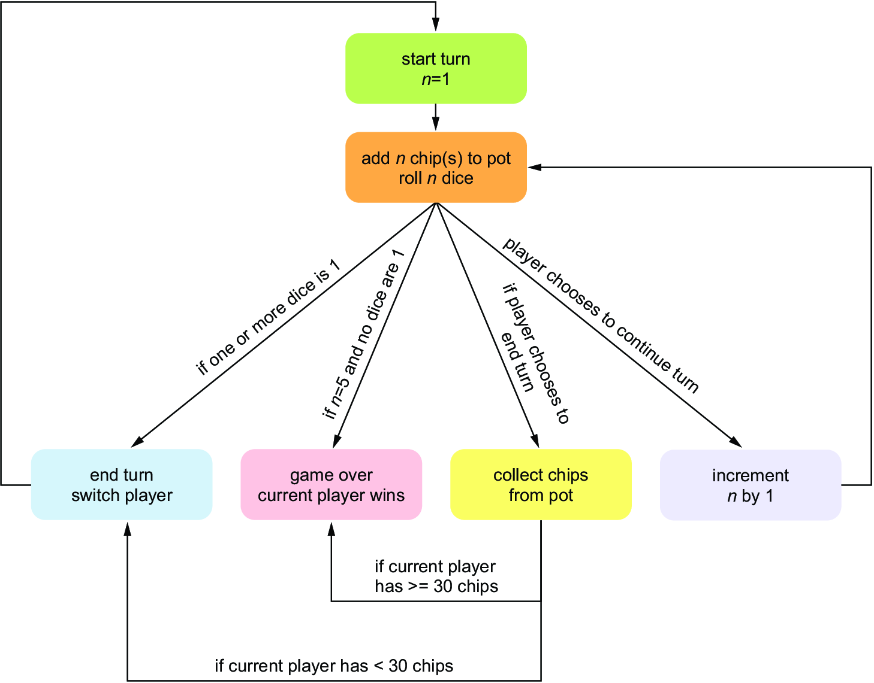
Follow the turn-flow diagram to see how rolling, continuing, stopping, and losing determine the player’s next state. section 10.4.1

