A point mass is a spike of probability at one exact value rather than a spread across an interval. It signals that a particular outcome occurs unusually often. section 7.3.1
Rainfall provides an intuitive example: most days receive no rain, creating a large point mass at zero, while rainy days form a right-skewed positive tail. A single distribution may therefore be inadequate. section 7.3.1
Modeling implications include:
- Use a Poisson component for the zero spike and a gamma component for positive, continuous values. section 7.3.1
- Use Tweedie distributions with 1 < p < 2 for compound Poisson-gamma loss functions. section 7.3.1
- Inspect the target histogram before choosing a regression loss; zero concentration and a long tail can guide the choice. section 7.4.1
Bike-sharing demand
The number of casual bike users ranges from 0 to 367 and has a large point mass at zero, followed by a long right tail. A log transformation and a Tweedie model are suggested as useful modeling directions. section 7.4.1
Figure 7.11 Modeling some types of labels effectively requires combinations of distributions, called compound distributions. One such compound distribution is the Tweedie distribution.
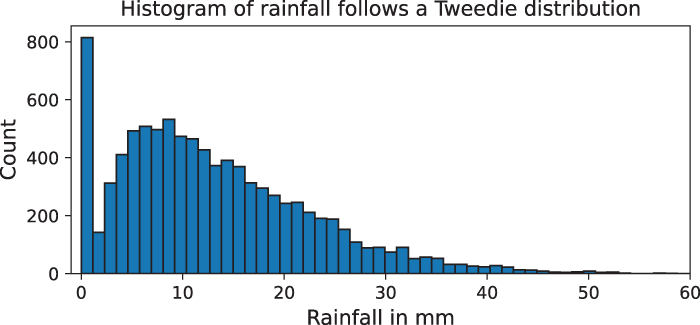
Shows how compound distributions combine a zero-focused component with a continuous positive component. section 7.3.1
