A Poisson-gamma distribution models hybrid targets with many exact zeros, plus positive continuous values that are typically right-skewed. It combines a Poisson component for the zero-heavy event count with a gamma component for positive magnitudes. section 7.3.1
Use the distribution when the target shows this pattern:
- A large point mass occurs at zero, representing days or cases with no events. section 7.3.1
- Positive observations vary continuously and form a right-skewed tail. section 7.3.1
- A Tweedie distribution with 1 < p < 2 provides the corresponding compound loss family. section 7.3.1
Rainfall and bike-sharing demand
Rainfall has many zero-rain days and occasional heavy rainfall, making the compound structure intuitive. UCI Bike Sharing casual-user counts show a related long-tailed pattern; their log-transformed histogram resembles the rainfall pattern and motivates Tweedie modeling. section 7.3.1 section 7.4.1
Figure 7.11 Modeling some types of labels effectively requires combinations of distributions, called compound distributions. One such compound distribution is the Tweedie distribution.
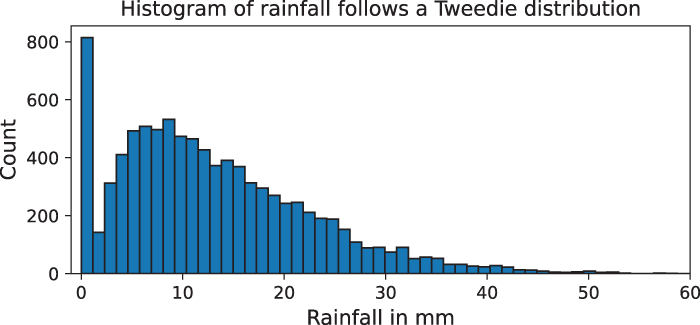
Use the distribution-comparison figure to see why compound distributions capture both the zero spike and the positive right-skewed tail. section 7.3.1
