A policy gradient method optimizes a parameterized policy by estimating how changes to its parameters affect expected return. In reinforcement learning, the policy assigns action probabilities from observations, and training seeks a policy that maximizes cumulative discounted reward. section 12.1.2
Choosing a move in Reach the Treasure
Suppose an agent observes a situation and assigns 0.4 probability to moving left and 0.6 to moving right. Combining these action probabilities with possible rewards produces an expected return of 5.728 for one trajectory. Policy optimization uses this return-oriented objective to improve the action policy. section 12.1.2
The method connects policy choice with reward optimization:
- Represent decisions as probabilities over available actions given an observation. section 12.1.2
- Evaluate choices through expected cumulative discounted reward, with the discount factor controlling emphasis on immediate versus future rewards. section 12.1.2
- Use policy gradients alongside value iteration and policy iteration as iterative approaches to learning an effective policy. section 12.1.2
- Apply the approach to combinatorial optimization: a reinforcement-learning model can use policy gradients to minimize the predicted tour length for the traveling salesperson problem. section 11.7
Figure 12.4 Reach the Treasure game
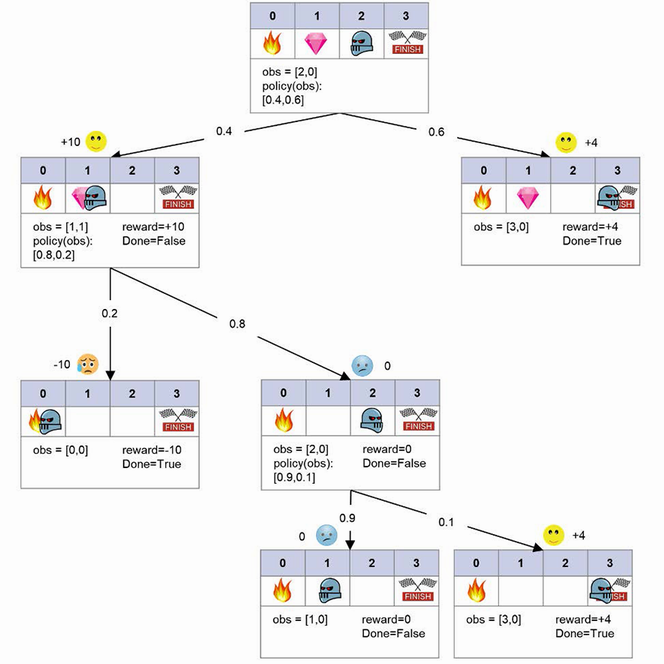
Use the Reach the Treasure game to inspect how action probabilities, trajectories, and rewards combine into an expected return. section 12.1.2


