A policy owner is the person or organizational role responsible for keeping an authorization policy relevant and aligned with business intent. The owner is usually the manager accountable for the related product or feature area. section 14.3.2
Ownership does not mean performing every policy task. Authors implement the rule, reviewers evaluate the implementation, approvers confirm intent and scope, coordinators check alignment with shared standards, and auditors verify that governance operates as expected. section 14.3.2 section 14.3.1
A policy owner helps maintain accountability across the policy lifecycle:
- Keeps the policy relevant as product behavior, business requirements, and authorization conditions change. section 14.3.2
- Connects deployed behavior to business intent through policy metadata, decision records, and review artifacts. section 14.3.1 section 17.5
- Uses incidents, audit findings, monitoring results, and decision logs to identify policies that need review. section 14.3.1 section 17.5
- Works within federated governance: teams retain local ownership while shared standards preserve organization-wide coherence. section 14.3.1
Tracing an unexpected access decision
Suppose support agents can view customer documents, but overlapping policies grant broader access than intended. Decision logs reveal the unexpected outcome, governance links the decision to the responsible policy owner and recorded business intent, and the owner helps determine whether revision is needed. section 17.3.1 section 17.5
Figure 14.5 Policy governance workflow across roles. Authorization policies move through clearly defined roles, from creation to deployment and review. Engineers author and review policy logic, managers approve intent and scope, access control coordinators ensure alignment across teams, and auditors verify that governance processes are followed over time. Separation of duties and feedback loops preserve accountability without centralizing control.
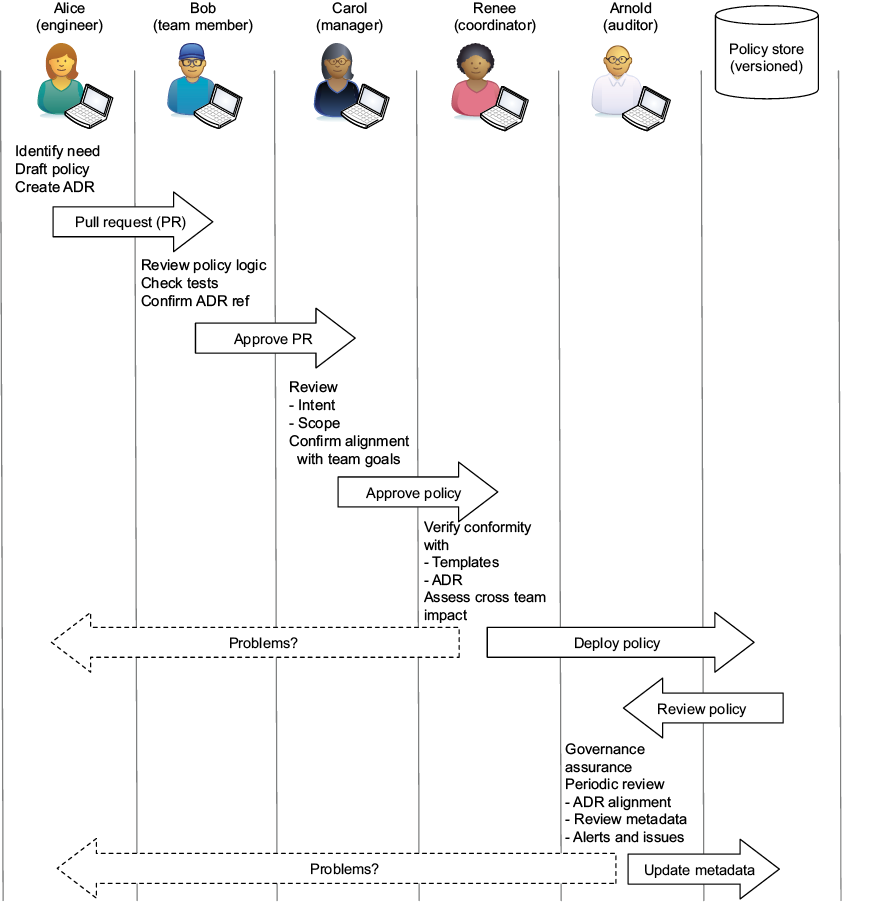
Shows how ownership fits with authoring, review, approval, coordination, deployment, and ongoing audit without centralizing every policy decision. section 14.3.2
