liveBook · Manning

Importance weight

As explained in Optimization Algorithms: AI techniques for design, planning, and control problems

A probability ratio is the quotient of an action probability under an updated policy and its probability under an old policy.

An importance weight compares how likely the same action is under an updated policy and an older policy: r(θ) = updated probability ÷ old probability. A value above 1 means the action became more likely; a value between 0 and 1 means it became less likely. section 12.1.5

In PPO-CLIP, the ratio scales the policy-gradient objective while clipping limits the effective update to 1 − ε through 1 + ε. With ε = 0.2, the intended range is 0.8 to 1.2, helping prevent an excessively large policy change. section 12.1.5

Reading a ratio

For a sampled state and action, a ratio of 1.15 means the updated policy assigns 15% more probability to that action. A ratio of 0.7 means it assigns less probability than before; PPO may clip its contribution when the ratio moves beyond the allowed range. section 12.1.5

Figure 12.6 Clipped surrogate objective in PPO
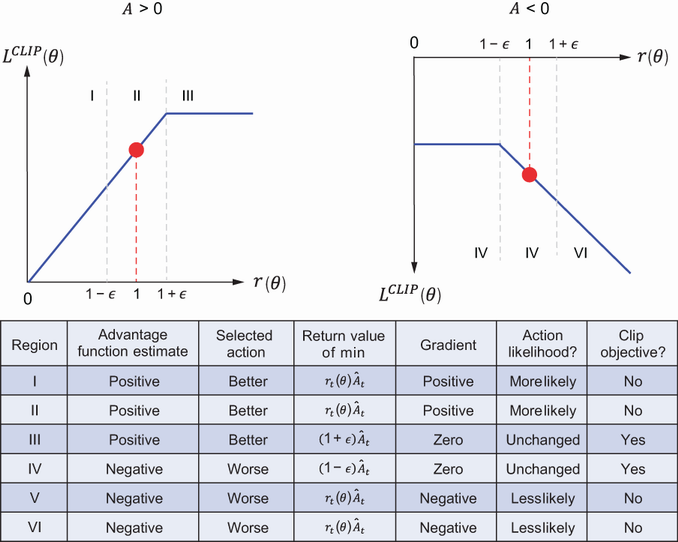
Use the clipped-surrogate-objective figure to see how probability ratios and advantage estimates determine PPO’s update behavior. section 12.1.5


How Optimization Algorithms: AI techniques for design, planning, and control problems covers it

How deep it goes
Defines ratio direction and clipping behavior, but stops short of deriving the full surrogate objective.
Examples
Uses sampled state-action probabilities, ratios above or below one, and an example clipping parameter of 0.2.
What it assumes
Assumes probability distributions and policy-gradient terminology while defining the ratio’s directional meaning.
What you can do after
Evaluate PPO policy changes by interpreting action-probability ratios and their clipping range.
How it connects
Connects probability ratios with PPO, policy gradients, advantage estimates, clipping, and KL divergence.

Also explained in

Compare how 3 books explain importance weight →

Related concepts

This explainer was generated by Manning's knowledge graph from the text of Optimization Algorithms: AI techniques for design, planning, and control problems. The section links point to the parts of the book it draws on.
