A polyline is an ordered chain of connected line segments, represented compactly by its successive points. In two-dimensional geometry, an array of points preserves which segments share endpoints without redundant data, making the representation useful for storage and processing. section 11.2
Approximating a curve
A smooth curve can be replaced by a sequence of straight segments. The result is less exact but easier to store and process, making a polyline a practical approximation for graphics and geometric modeling. section 11.2
Polylines make several geometric operations uniform:
- Triangle meshes turn intersections that would otherwise be circles, conic sections, or polynomial curves into polylines of straight segments. section 11.2.2
- A common segment-based representation lets the same intersection code handle many modeled shapes. section 11.2.2
- Approximation quality is an engineering trade-off: too few segments lose useful shape, while too many make processing implausibly expensive. section 11.2.2
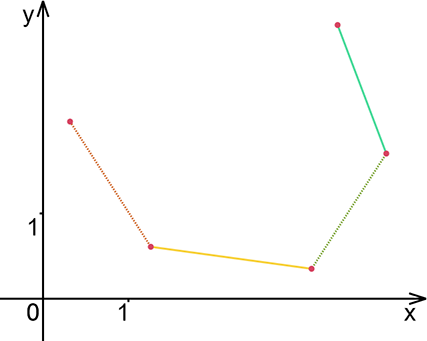
A first-degree NURBS is a continuous but nonsmooth polyline; N control points form N−1 segments. section 7.3.1
