liveBook · Manning

Root

As explained in Geometry for Programmers

A polynomial root is a value of the variable at which the polynomial evaluates to zero.

A polynomial root is a value of x that makes P(x) = 0. Geometrically, it is where the polynomial’s graph intersects or touches the x-axis. section 6.1 section 6.1.1

A degree-n polynomial has at most n roots. Linear polynomials have one root; quadratics may have zero, one, or two; cubics may have one, two, or three. Odd-degree polynomials must have at least one real root, while even-degree polynomials may have none. section 6.1.1 section 6.1.3

Reading roots from a graph

For y = ax² + bx + c, inspect the parabola: two crossings indicate two roots, one touch indicates a repeated root, and no contact indicates no real roots. A factored cubic, P(x) = (x − r₁)(x − r₂)(x − r₃), has roots r₁, r₂, and r₃ because each factor becomes zero at its matching value. section 6.1 section 6.1.1
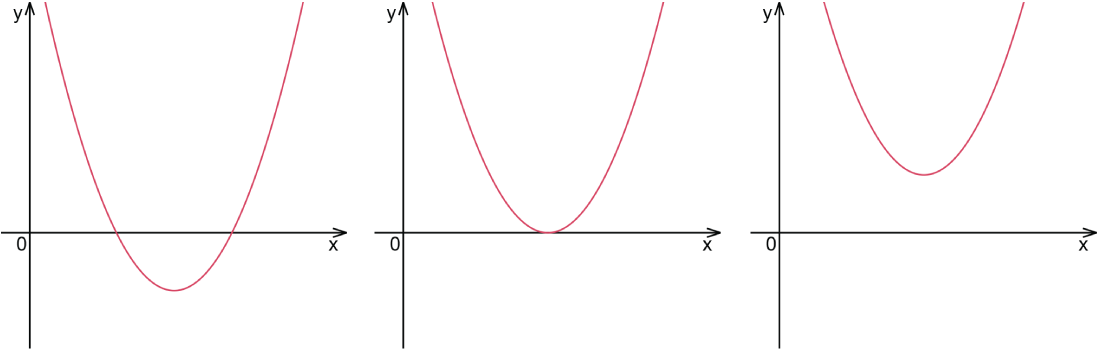
Figure 6.2 A quadratic polynomial may intersect the x-axis twice, touch it once, or ignore it.
06-02

Use the parabola figure to compare two crossings, a single touch, and no x-axis intersection. section 6.1.1

Roots also connect to polynomial derivatives: a derivative root can mark a local maximum or minimum of the original polynomial when the derivative changes sign across the x-axis. In interpolation, many derivative roots can create unwanted bumps and oscillations. section 6.1.2 section 6.3.2


How Geometry for Programmers covers it

How deep it goes
Defines roots geometrically, classifies root counts by degree, and links derivative roots to extrema; it stops short of root-solving algorithms.
Examples
Uses factored cubics, linear graphs, quadratic parabolas, cubic graphs, and interpolating polynomials with increasing oscillations.
What it assumes
Builds from linear equations and functions before extending root reasoning to quadratic and cubic polynomials.
What you can do after
Evaluate polynomial graphs by identifying their roots, possible root counts, and relationships between derivative roots and extrema.
How it connects
Connects roots with polynomials, polynomial equations, graphs, derivatives, extrema, interpolation, and Runge’s phenomenon.

Also explained in

Compare how 2 books explain root →

Related concepts

This explainer was generated by Manning's knowledge graph from the text of Geometry for Programmers. The section links point to the parts of the book it draws on.