Popularity bias occurs when a recommender gives popular items disproportionate exposure or recommendation frequency. In a feedback loop, exposure generates interactions, interactions reinforce popularity, and the catalog's long tail becomes less visible. section 1.6 section 4.6.4
Popularity bias appears in several parts of a recommender system:
- Collaborative filtering can repeatedly surface items that already have abundant interaction data. section 1.6
- Low item coverage reveals that recommendations concentrate on a small portion of the catalog. section 4.6.4
- Exploration competes with exploitation: proven popular items are safer choices, while less-known items receive fewer opportunities to generate evidence. section 1.6
- Popularity bias can reduce aggregate diversity even when individual recommendations achieve strong precision. section 4.6.4
A coverage warning
An ALS model recommends only 2.6% of the available catalog, with more than half of those recommendations coming from the most popular quartile. Compare this with a popularity baseline, which has 100% coverage by recommending the same top-tier items to everyone. section 4.6.4
Figure 4.18 ALS recommends only a small percentage of available items.
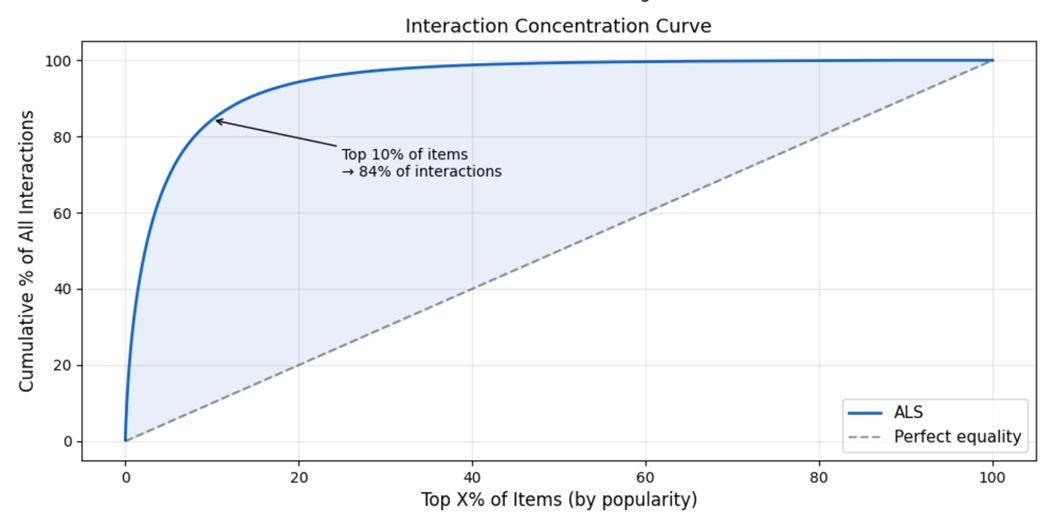
Use the catalog-coverage figure to inspect how a personalized model concentrates recommendations on a small set of items. section 4.6.4