A portfolio-based approach manages initiatives as a balanced set of investments, connecting technical decisions to business outcomes across different time horizons. It combines short-term wins with deliberate action on fundamental, long-term challenges. section 3.4
Apply the approach by:
- Treating each business subdomain as an investment opportunity and varying modernization effort according to its potential business return. section 10.0
- Investing more in strategically important areas, where speed, control, innovation, and collaborative discovery matter most. section 10.0
- Using proportionate solutions elsewhere, such as off-the-shelf tools, outsourcing, simple forms over data, or low-code solutions. section 10.0
Balancing modernization horizons
An organization may prioritize immediate value while continuing to address a monolithic legacy database coupled to everything. A strategically important subdomain might justify in-house development, product discovery, and EventStorming, while a low-impact capability may need only a simple CRUD interface. section 3.4 section 10.0
Figure 10.1 This chapter shows how to take a portfolio perspective and verify each candidate value stream fits into the bigger picture.
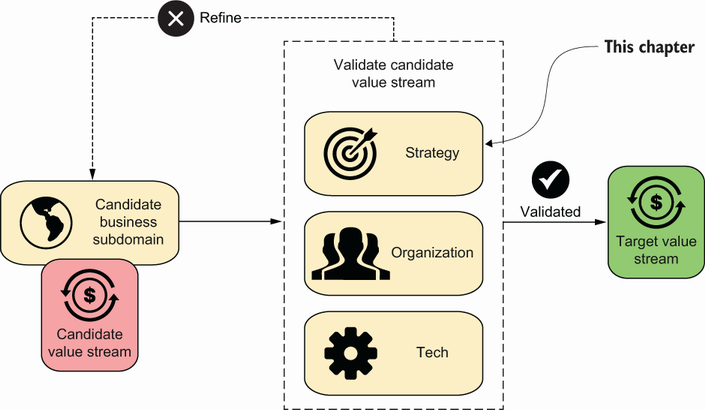
Use the portfolio view to verify that each candidate value stream contributes to the wider strategic picture. section 10.0
