A position specifies where a point or object is located relative to a reference or coordinate system. Numeric coordinates make locations easier to calculate with in software than descriptions such as “in the second drawer.” section 6.1.1
Represent positions by the coordinates required by the space:
- Use (x, y) for a 2D position and (x, y, z) for a 3D position. section 6.1.1
- Treat dimension as the number of independent coordinates needed to specify position alone. section 6.1.1
- Distinguish position from pose: pose specifies both position and orientation. section 6.1.1
Coordinate examples
A point can be represented as (4, 2) in 2D or as position (5, 2, 0) in 3D. These forms support calculations such as finding the distance between two positions. section 6.1.1
Figure 6.2 Spaces with 1D, 2D, and 3D dimensions require varying numbers of pose parameters (PP) to fully define an object’s position and orientation, with up to 6 PP needed for a 3D object in 3D space.
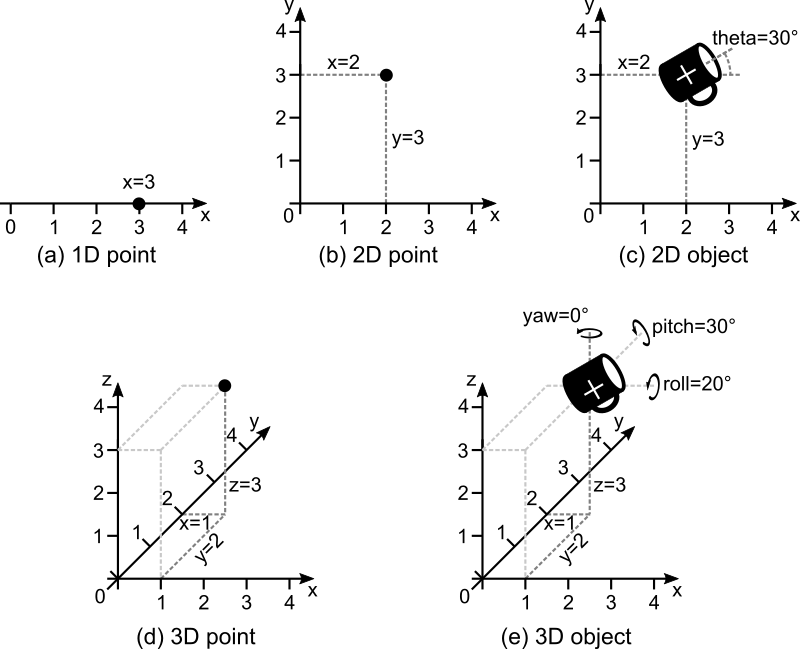
Compare how 1D, 2D, and 3D spaces require different numbers of pose parameters to fully define an object. section 6.1.1
