liveBook · Manning

POSIX Threads API

As explained in Learn Concurrent Programming with Go

POSIX Threads is a standardized API and specification for creating, managing, and synchronizing threads.

POSIX Threads (pthreads) is an IEEE-standardized API for creating, managing, and synchronizing threads. Implementations exist across UNIX and Windows systems, while languages may expose different thread models or omit POSIX support. section 2.2.4

Keep these distinctions in view:

  • Operating systems use different creation mechanisms, such as Windows CreateThread and Linux clone with CLONE_THREAD. section 2.2.4
  • Languages model concurrency differently: Java uses thread objects, Python limits parallel thread execution with a global interpreter lock, and Go uses goroutines. section 2.2.4
  • The API differs by implementation, but multithreading concepts and techniques remain broadly transferable. section 2.2.4
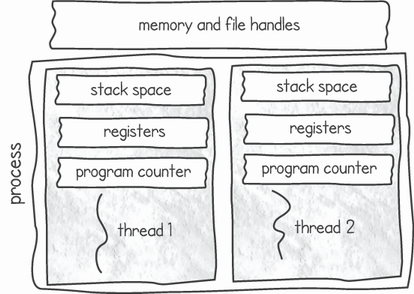
Figure 2.6 Threads sharing the same process memory space

Visualizes threads sharing a process memory space, a central concern when managing concurrent execution. section 2.2.4


How Learn Concurrent Programming with Go covers it

How deep it goes
Explains the standard’s role and implementation differences but defers detailed API calls and operating-system internals.
Examples
Contrasts Windows CreateThread, Linux clone with CLONE_THREAD, Java threads, Python’s global interpreter lock, and Go goroutines.
What you can do after
Evaluate/understand how thread implementations differ while recognizing transferable multithreading techniques.
How it connects
Connects threads with process memory, synchronization, operating systems, goroutines, and language-specific thread models.

Also explained in

Compare how 2 books explain POSIX Threads API →

Related concepts

This explainer was generated by Manning's knowledge graph from the text of Learn Concurrent Programming with Go. The section links point to the parts of the book it draws on.