People encounter barriers to web content for many reasons, including differences in vision, hearing, movement, or the ways they interact with technology. The POUR principles organize accessibility around what people need to perceive, operate, and understand content—and whether it works across technologies—rather than around a particular web framework. section 1.5.1
POUR names four goals for content and functionality:
- Perceivable: available through different senses. section 1.5.1
- Operable: usable in different ways. section 1.5.1
- Understandable: clear and predictable. section 1.5.1
- Robust: works across a wide range of technologies, including assistive technologies. section 1.5.1
The principles are a starting point, not a conformance checklist. In WCAG 2.2, they organize 13 guidelines. Each guideline has testable success criteria: the requirements used to determine conformance at levels A, AA, or AAA. The levels are cumulative. section 1.5 section 1.5.1
From a goal to a technique
If people need to find the main content, a documented general technique adds a link at the top of the page that goes straight there. Another documented HTML technique uses h1–h6 elements to identify headings. Techniques help put accessibility goals into practice; check the relevant success criteria to determine conformance. section 1.5.1
TIP: Use the WCAG Quick Reference to filter guidelines, success criteria, techniques, and failures for the technology you are developing. section 1.5.1
Figure 1.2 This image illustrates the various components in WCAG 2.2. Guidelines are organized under four principles. Each of the 13 guidelines includes normative success criteria: the requirements used to determine conformance at levels A, AA, or AAA. WCAG also provides informative supporting material, including techniques, understanding documents, testing rules, and additional guidance to help explain and apply those requirements.
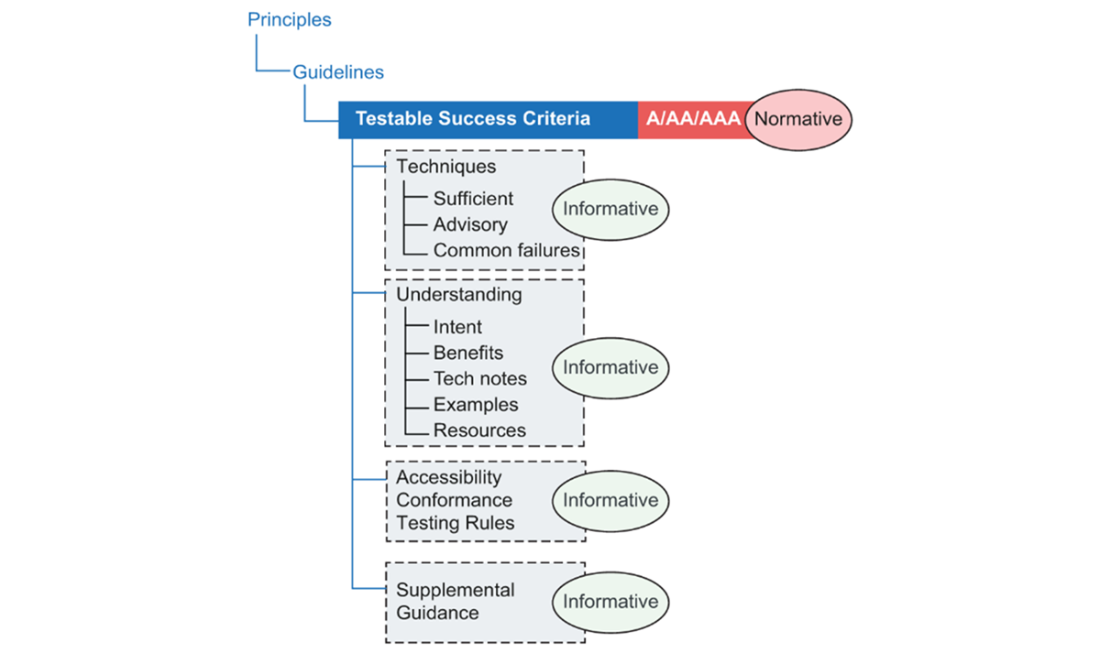
See how the four principles lead to guidelines and normative success criteria, alongside supporting techniques and guidance. section 1.5.1