A query can ask for a connection that no single passage states. Searching for the query’s words may miss the person, event, or document that joins its named entities. Personalized PageRank (PPR) addresses this retrieval problem by ranking nodes according to their connections to query-specific seed nodes, rather than their importance to the graph as a whole. section 12.3.1
Ordinary PageRank models a random walk that follows links and periodically restarts, producing a global importance score. PPR directs those restarts back to specified seeds. Probability spreads along graph edges but repeatedly returns to the query’s starting points, so connected nodes can score highly even when their names never occur in the query. section 12.3.1
Finding an unmentioned bridge
For “Which Stanford professor works on Alzheimer’s?”, Stanford and Alzheimer’s are seeds. In an illustrative graph, a professor connected to both receives a score of 0.207—the highest score among nodes absent from the question. A node one hop from only one seed scores 0.134. The bridge becomes retrievable without a keyword match on the professor’s name. section 12.3.2
Figure 12.4 The associative ripple.
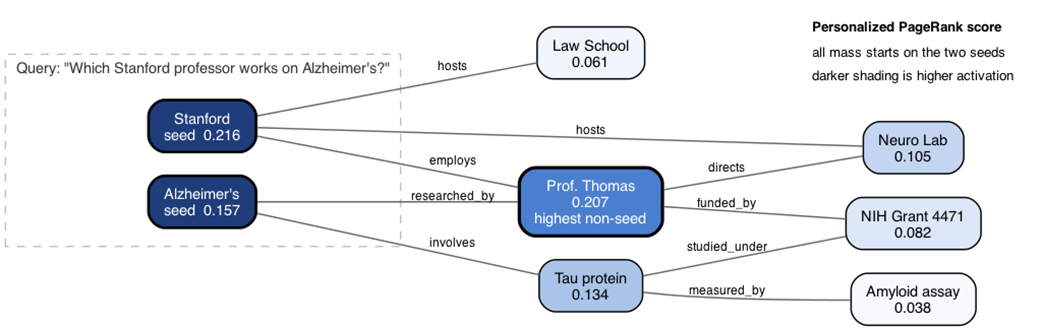
The graph illustration shows activation spreading from two query seeds and accumulating at an unmentioned connecting node. section 12.3.2
A PPR retrieval path has four practical steps:
- Extract entity and noun-phrase candidates from the query, then match their strings to nodes in an already built entity graph; synonym matching matters when query wording differs from node names. section 12.3.4
- Put personalization mass on those seed nodes and run the walk to convergence. The damping factor is the probability of following an edge instead of returning to the seeds: higher values explore farther, while lower values stay more query-focused. section 12.3.4
- Sort nodes by PPR score, aggregate their activation back to passages, and give the highest-ranked passages to the answer-generating LLM. section 12.3.3
- Check whether the chosen seeds and passage cutoff expose the needed bridge. A walk can reach a relevant node yet rank it below unrelated neighbors of a well-connected seed. section 12.4.4
Listing 12.4 Associative Retrieval.
from typing import List, Tuple

class AssociativeRetriever:
    """Implements retrieval using Personalized PageRank."""

    def __init__(self, graph: nx.DiGraph):
        """Initialize with a populated knowledge graph."""
        self.graph = graph

    def retrieve(
        self, query_seeds: List[str], damping: float = 0.5
    ) -> List[Tuple[str, float]]:
        """Execute probability flow from seed entities."""
        personalization = {  #A
            node: (1.0 if node in query_seeds else 0.0)
            for node in self.graph.nodes()
        }

        ppr_scores = nx.pagerank(  #B
            self.graph,
            alpha=damping,
            personalization=personalization
        )

        return sorted(  #C
            ppr_scores.items(),
            key=lambda x: x[1],
            reverse=True
        )[:5]  #D
The NetworkX example builds a seed-only personalization vector, calls pagerank with a damping value of 0.5, and returns the five highest-scoring nodes. section 12.3.4
In HippoRAG, the entity graph is prepared during indexing; PPR then finds multi-hop associations in one retrieval pass. IRCoT instead alternates LLM reasoning with further retrieval, paying for a reasoning call at each step. The single-pass approach depends on a useful graph and reliable seed extraction. In one small-graph illustration, changing damping from 0.15 to 0.85 barely improved a hidden node’s rank because node degree dominated; tuning the walk did not repair the missing seed. section 12.3.3 section 12.4.4

