liveBook · Manning

Precision medicine

As explained in Knowledge Graphs and LLMs in Action

Personalized medicine is an approach to healthcare that tailors prevention, diagnosis, or treatment to individual patient characteristics.

Precision medicine tailors disease prevention or treatment to patient-specific information, including genetics, environment, lifestyle, and clinical history. section 4.4

A practical precision-medicine pipeline integrates:

  • Patient data from electronic health records with genomics, proteomics, transcriptomics, and other multi-omics datasets. section 4.4
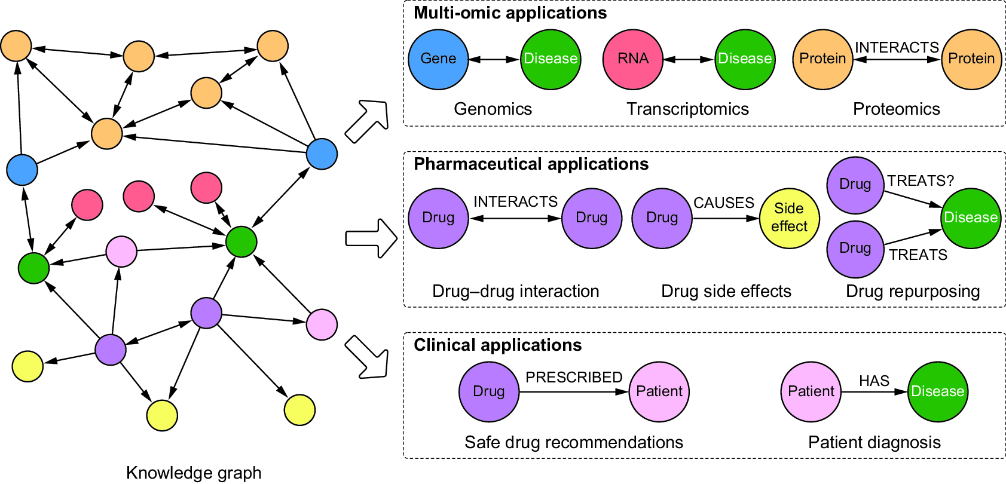
  • Biomedical knowledge graphs whose nodes represent patients, drugs, and diseases and whose edges encode diagnoses, treatments, and associations. section 4.1 section 4.4
  • Queries and analyses that support diagnosis, treatment selection, drug repurposing, and safer-drug recommendations. section 4.1
Figure 4.1 The primary types of biomedical applications for KGs, grouped by business goal. They have many data sources in common.
figure

Use the application map to relate precision medicine to shared biomedical data sources, graph entities, and other knowledge-graph goals. section 4.1

How Knowledge Graphs and LLMs in Action covers it

How deep it goes
Explains the integration pipeline and data challenges but stops short of prescribing a validated clinical treatment workflow.
Examples
Uses patient–drug–disease graphs, cancer patient journeys, protein–disease associations, and drug-repurposing analyses.
What you can do after
Evaluate patient-care possibilities by integrating clinical records and multi-omics data into analyzable knowledge graphs.
How it connects
Connects electronic health records, multi-omics, biomedical knowledge graphs, clinical pathways, and patient journey mapping.

This explainer was generated by Manning's knowledge graph from the text of Knowledge Graphs and LLMs in Action. The section links point to the parts of the book it draws on.