Preclinical development evaluates a drug candidate’s safety and efficacy before human clinical trials, typically through testing in animals or model organisms. section 1.4.2 section 1.4.3
Preclinical evaluation supports several practical decisions:
- Assess whether an optimized lead compound shows sufficient safety and efficacy to advance. section 1.4.2
- Inform the candidate’s dosage, formulation, and administration for later clinical testing. section 1.4.2
- Serve as a gate between lead optimization and clinical trials, where testing shifts to human participants. section 1.4 section 1.4.3
Figure 1.11 We can breakdown drug design into target identification and validation, hit discovery, hit-to-lead (lead identification), lead optimization, and preclinical development. Once a drug candidate has progressed to the drug development stage, it will need to pass multiple phases of clinical trials testing safety and efficacy prior to submission to and review by the FDA and launch to market.
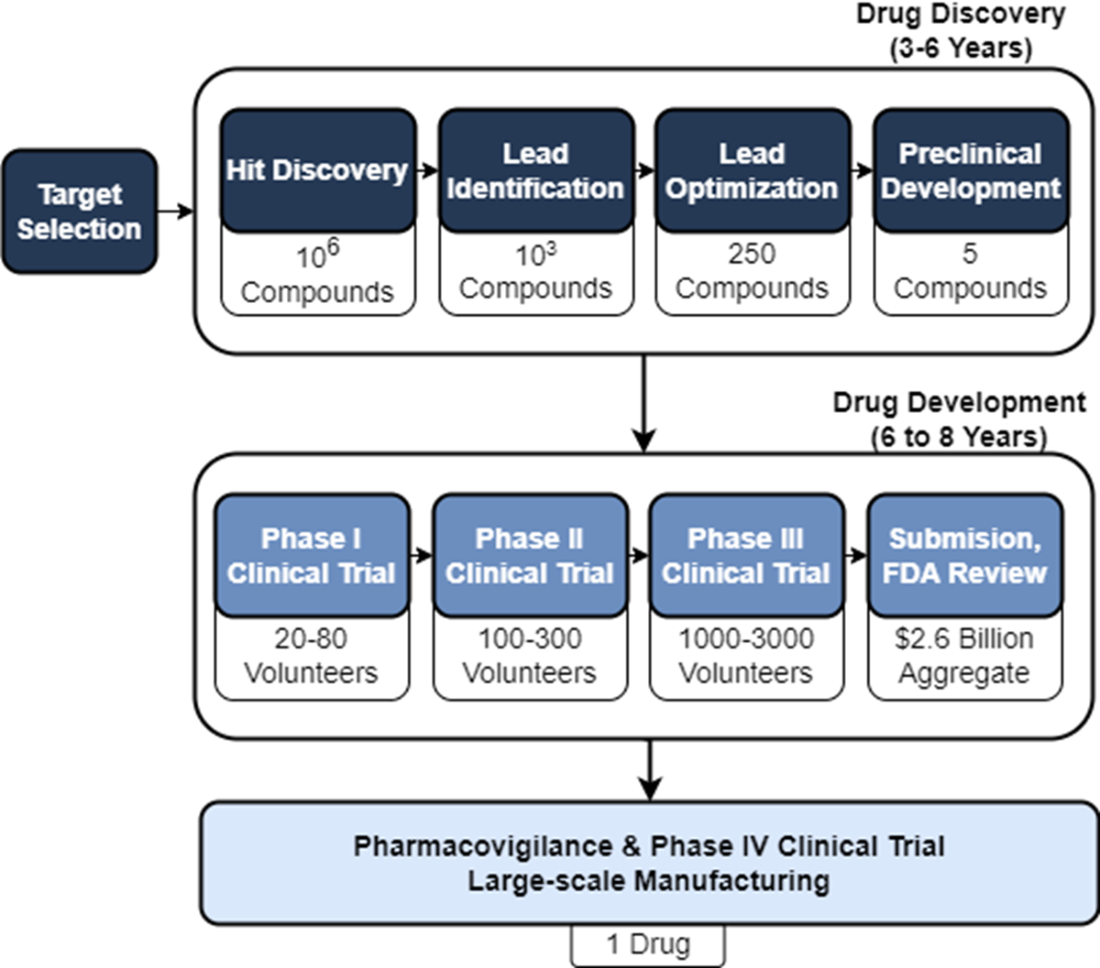
The pipeline view places preclinical development after target identification, hit discovery, lead identification, and lead optimization, and before human clinical trials. section 1.4
