Preference displacement is a potential DPO failure mode in which optimization shifts probability mass away from both chosen and rejected responses, with the rejected response decreasing more. The proposed consequence is increased probability for unaddressed behaviors—tokens the model can generate but that preference-training data does not represent. section 8.2 section 8.6
DPO increases the margin between chosen and rejected completions rather than directly preserving the chosen response’s probability. This objective can therefore improve the relative margin while reducing both probabilities. The exact practical impact remains uncertain, and the effect is proposed as one reason online methods may outperform vanilla DPO. section 8.2 section 8.6
Mitigation strategies change either the optimization or the training data:
- Cal-DPO adjusts the optimization process, while AlphaPO modifies the reward shape. section 8.2
- Online DPO generates completions from the current model, and D2PO creates preference data through reward-model relabeling. section 8.2
Figure 8.1 Sketch of preference displacement in DPO
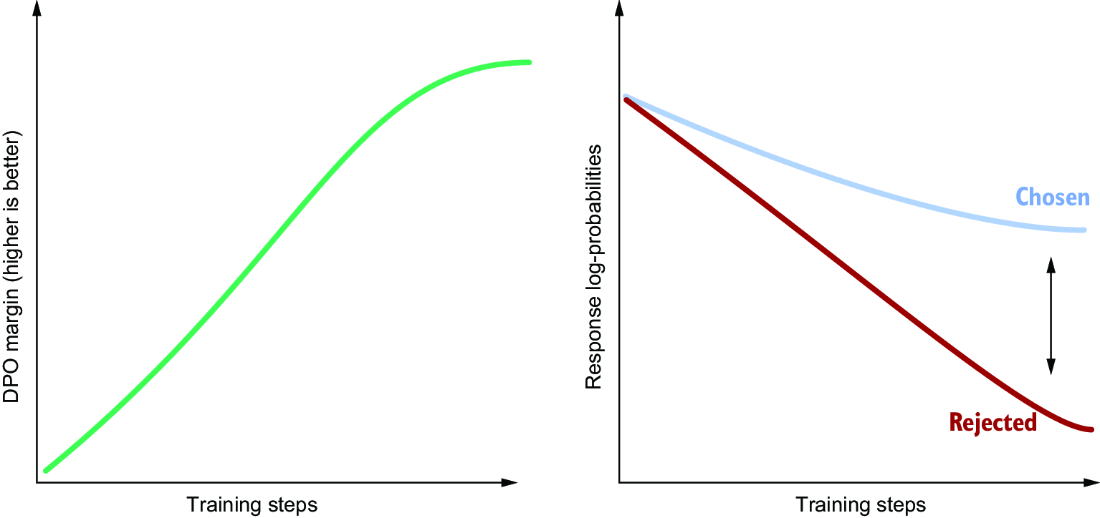
Use the sketch to compare how DPO changes the probabilities of chosen and rejected responses. section 8.2
