Preference elicitation obtains information about what a person prefers. Asking someone to choose between two products can be easier and more consistent than requesting an absolute numerical rating. section 10.0
In preference optimization, each comparison supplies data about an unknown objective defined by the user’s preferences. A Gaussian-process model can learn from these comparisons, while Bayesian optimization selects new comparisons that balance exploitation of the best known option with exploration of promising alternatives. section 10.0
A practical preference-elicitation loop:
- Present two candidate products or data points. section 10.0
- Record which candidate the user prefers. section 10.0
- Update a model of the user’s preference and compare the best known point with a promising rival. section 10.0
Choosing Hawaiian shirts
An online shop can ask a customer to rate a Hawaiian shirt from 1 to 10 or choose which of two shirts they like better. The pairwise choice is the easier elicitation task. section 10.0
Figure 10.1 Examples of user’s preference elicitation in production recommendation. On the left, the user is asked to rate a recommended product. On the right, the user is asked to pick the product they like better. The latter situation helps better elicit the user’s preference.
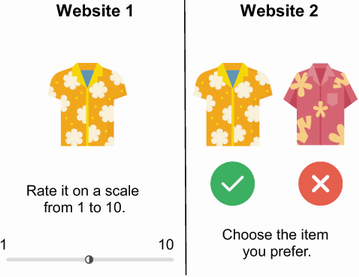
Compare rating-based and pairwise interfaces for eliciting product preferences. section 10.0
