Preference modeling learns what a user prefers from judgments or pairwise comparisons rather than requiring numerical evaluations. In Bayesian optimization, the system presents two candidate points and uses the user's choice to guide the search. section 10.4
A practical “king of the hill” strategy pairs the best point found so far—the incumbent—with a challenger selected by a BayesOpt acquisition policy. Repeating this comparison balances exploitation of promising regions with exploration of uncertain ones. section 10.4
Choosing the next comparison
Use an acquisition policy such as UpperConfidenceBound or qNoisyExpectedImprovement to optimize an acquisition function, stack its challenger with the incumbent, collect the user's comparison, and append the resulting preference data.
Figure 10.7 Illustration of the “king of the hill” strategy in Bayesian preference optimization. We compare the best point we have seen so far against a promising candidate identified by a BayesOpt policy.
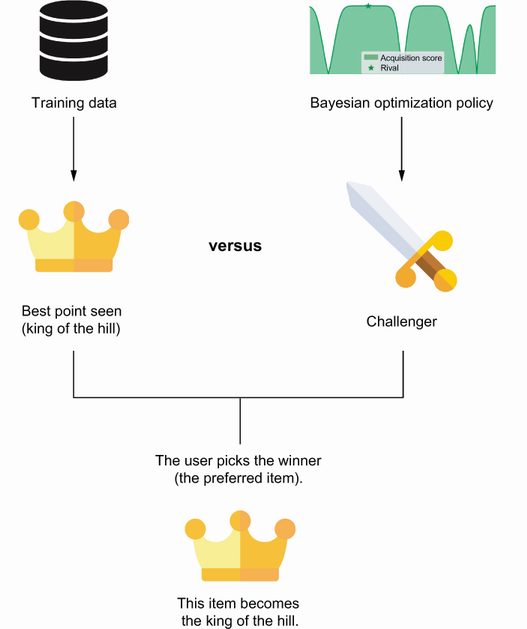
Illustrates the incumbent-versus-challenger comparison at the center of Bayesian preference optimization. section 10.4
