Present value measures what future cash flows are worth today after accounting for when those payments arrive. It turns long-term financial choices into comparable values. section 1.3
The measure supports practical decisions such as choosing when to claim Social Security or deciding whether tax savings today outweigh a larger tax bill later. Timing, lifespan, household rules, investment horizon, and future tax rates can materially change the result. section 1.3 section 14.1.3
Social Security claiming
A basic break-even comparison evaluates claiming at age 62 versus age 70. If someone expects to live past 82, waiting until 70 produces the larger present value; dying before 82 favors claiming at 62. At age 90, claiming at 70 produces roughly $500,000 in total present-value payments. Spouses and detailed Social Security rules make the analysis complex enough to require code rather than a simple spreadsheet. section 1.3
Present-value reasoning also clarifies when delaying taxes helps:
- Tax-loss harvesting is attractive when taxes avoided today exceed the present value of the additional taxes paid later. section 14.1.3
- The benefit can disappear with an investment horizon shorter than one year because long-term tax treatment may not apply. section 14.1.3
- A higher future tax rate can make harvesting a loss today counterproductive, especially when the current capital-gains rate is already low. section 14.1.3
Figure 1.2 Break-even analysis on the age to start claiming Social Security
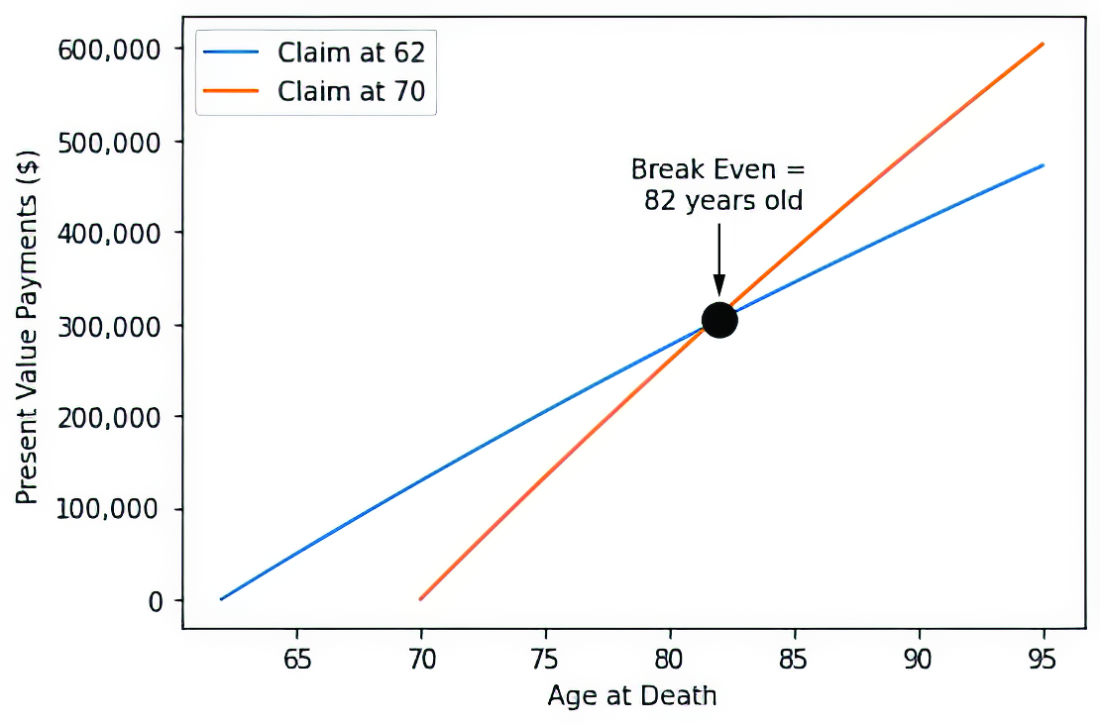
Compare the present value of Social Security payments under different claiming ages across expected lifespans. section 1.3
