A preview environment is a nonproduction environment outside a development team’s usual path to production, where software changes can be evaluated with the team’s services present. section 6.3.3 section 2.2.1
It addresses a testing gap: platform teams need isolated environments for upgrades and refactoring, but testing without real customer services misses user-impacting failures. section 6.3.3
A useful preview design should:
- Provide a namespace or equivalent environment in a preview cluster outside the normal production path. section 6.3.3
- Let platform teams observe how customer services respond to platform changes without blocking ordinary development. section 6.3.3
- Move changes from preview toward nonproduction and production only after observation and testing. section 2.2.1
- Combine status checks, functional tests, and observation of developer impact. section 8.6 section 2.2.1
Payments team
Suppose the Payments team normally moves through development, QA, and staging. Deploying a control-plane change to preview exposes failures in its services without disrupting the team’s regular delivery flow. section 6.3.3
Figure 6.9 For users of the platform, an environment in the path-to-production is a Kubernetes namespace. There will be one or more namespaces in a preproduction cluster, or eventually multiple clusters, where development teams test their application before deploying to a production cluster. Something you may not have seen before is the preview environment in the similarly named preview cluster.
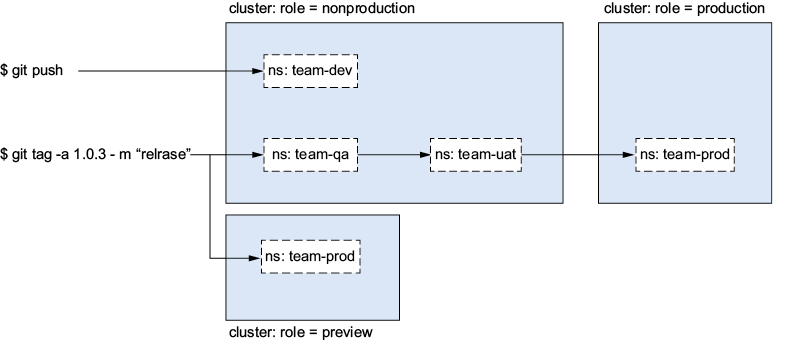
Use the architecture figure to compare ordinary Kubernetes namespaces in preproduction and production with the separate preview namespace and cluster. section 6.3.3
