A prime number is a positive integer greater than one with no positive divisors other than one and itself. Prime numbers provide the modulus that turns ordinary integers into finite fields for cryptographic computation. section 2.0 section 2.1
Prime numbers matter here because they support several connected mechanisms:
- Define a finite field whose elements wrap around modulo a prime number. section 2.1
- Provide the setting for modular operations, quadratic residues, and square-root calculations. section 2.0
- Supply the large field and curve cardinality parameters needed for elliptic-curve cryptography. section 5.3 section 6.3
A prime field as a clock
Using 43 as the prime modulus produces a field with elements that wrap from 42 back to 0. This clock-like model makes modular addition concrete while preserving the field’s required identity elements, 0 and 1. section 2.1
Figure 2.2 Finite field over prime numbers viewed as a clock (\(p=43\))
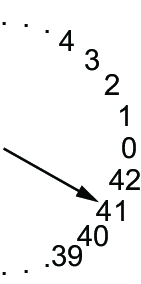
Visualizes the elements of a finite field modulo the prime 43 as positions on a clock. section 2.1