A class probability distribution represents predicted probabilities for classification outcomes. A trained classification algorithm generates a probability score for an unseen case, with values between zero and one, before a final business decision. section 1.5.1
Use the scores to:
- Distinguish binary outcomes such as churn or no churn, fraud or genuine, and pass or fail. section 1.5.1
- Handle multiclass targets such as positive, negative, or neutral. section 1.5.1
- Avoid treating unrestricted linear-regression outputs as probabilities, because they can fall below zero or exceed one. section 1.5.1
Telecom churn
A telecom operator trains on historical subscriber data containing revenue, service duration, average cost, monthly usage, and a churned yes/no target. The model produces a churn probability for each unseen customer, supporting the final retention decision. section 1.5.1
Figure 1.14 A linear regression model will not be able to do justice (left); hence, we have logistic regression for classification. Linear regression can generate probability scores more than 1 or less than 0 too, which is mathematically incorrect, whereas the sigmoid function generates probability scores between 0 and 1 only (right).
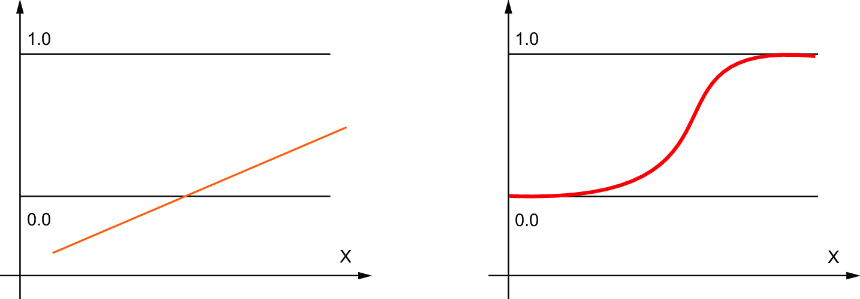
Compare invalid linear-regression outputs with sigmoid-generated scores constrained between zero and one. section 1.5.1

