The systematic reduction of the components and scope involved in a software defect until its source is identified.
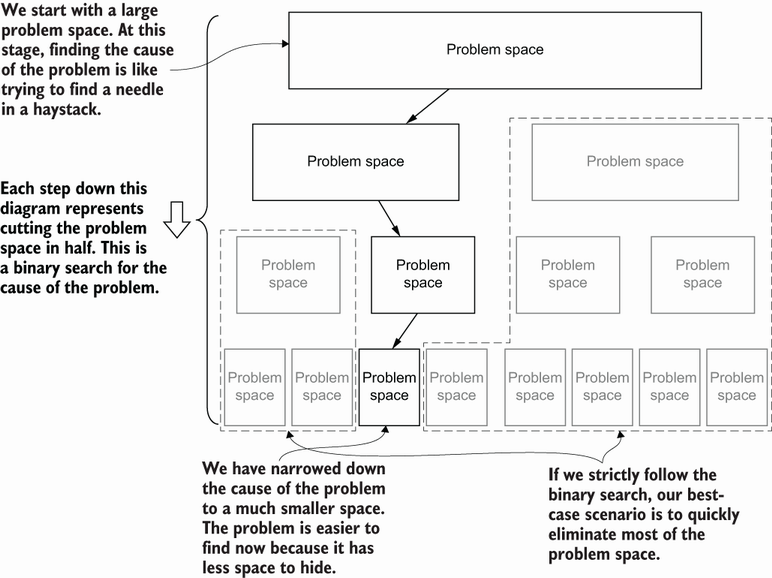
Problem isolation narrows a reproducible defect by repeatedly removing components and testing whether the failure remains. This divide-and-conquer approach reduces the space in which the cause can hide. section 11.3.1
Use a progressively smaller, repeatable debugging loop:
Reproduce the failure in development and, when possible, encode it in an automated test that initially fails. section 11.3.1
Remove one separable component, then ask whether the problem can still be reproduced. section 11.3.1
Treat continued failure as evidence that the removed component is less likely responsible; treat disappearance as evidence implicating it. section 11.3.1
Figure 11.11 Cutting away the problem space until we isolate the exact source of the bug
A visual model of cutting away the problem space until the defect’s exact source is isolated. section 11.3.1
How Bootstrapping Microservices, Second Edition: With Docker, Kubernetes, GitHub Actions, and Terraform covers it
How deep it goes
Explains reproduction, automated verification, component removal, and interpretation of results, but stops short of prescribing specific diagnostic tools.
Examples
Uses a failing automated test and removing microservices from a Docker Compose application as concrete isolation experiments.
What it assumes
Assumes a reproducible failure and a development environment, while teaching how to reduce the problem domain from there.
What you can do after
Diagnose/debug with repeatable experiments that narrow a defect to a specific application component.
How it connects
Connects automated testing, reproducibility, divide and conquer, microservices, and Docker Compose.
microservice architectureaddressed by · Microservice architecture is a software architectural style that organizes an application as independently deployable services with focused responsibilities that communicate through defined interfaces.
This explainer was generated by Manning's knowledge graph from the text of Bootstrapping Microservices, Second Edition: With Docker, Kubernetes, GitHub Actions, and Terraform. The section links point to the parts of the book it draws on.