A process reward model (PRM) scores intermediate reasoning steps instead of assigning one reward to an entire completion. It supports evaluating whether a chain of thought is progressing soundly and can guide search by pruning weak branches. section 5.5 section 5.6.1
Given prompt x and reasoning steps s₁…sₖ, a binary PRM estimates rθ(sᵢ | x, s<ᵢ), the probability that each step is valid. Training sums cross-entropy over annotated steps, not over every token. Multiclass implementations commonly predict incorrect, neutral, or correct at designated step boundaries. section 5.5
Distinguish a PRM from nearby reward signals by examining its prediction target and aggregation:
- A standard reward model produces one sequence-level score, commonly for reranking candidates or supplying a terminal RLHF reward. section 5.6.1
- An outcome reward model scores correctness across response tokens, whereas a PRM scores reasoning steps at their boundaries. section 5.5 section 5.6.1
- A value function estimates expected remaining return from a state and supports advantage computation; it is not a probability that the current step is correct. section 5.6.1 section 5.6
Boundary-masked training pipeline
Choose a separator such as a newline, append it to each completion, and place a label only at the final token of each reasoning step. Mask all other positions with -100. A language model's hidden states feed a three-class linear head; cross-entropy is computed only where labels are not masked. At inference, aggregate boundary scores by a mean, minimum, or weighted sum over steps. section 5.5 section 5.6.1
Figure 5.5 Process RMs provide supervision only at step boundaries (e.g., newline tokens). Each step receives a 3-class label: correct (+1), neutral (0), or incorrect (-1). All other tokens are masked during training.
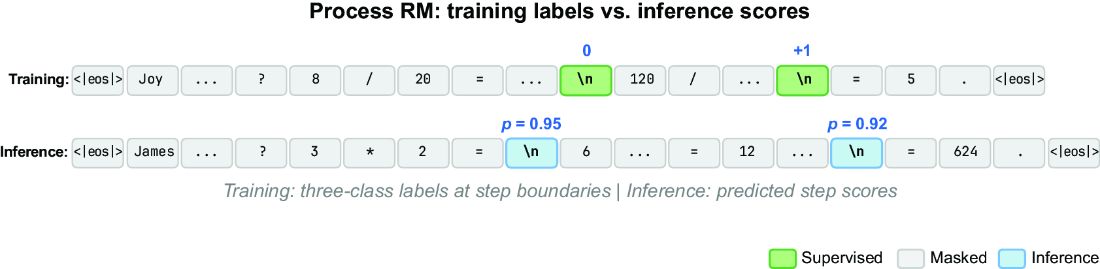
Use the figure to inspect how supervision appears only at reasoning-step boundaries and how correct, neutral, and incorrect labels are assigned. section 5.5
