A process signal evaluates how an agent reaches an output, step by step, rather than scoring only the final answer. section 1.4.1
Two forms assess the agent’s path:
- A Process Reward Model assigns credit to individual reasoning or tool-use steps. section 1.4.1
- A reflection signal has the agent or a critic critique its trajectory, which can reveal a fragile path even when the final answer looks fine. section 1.4.1
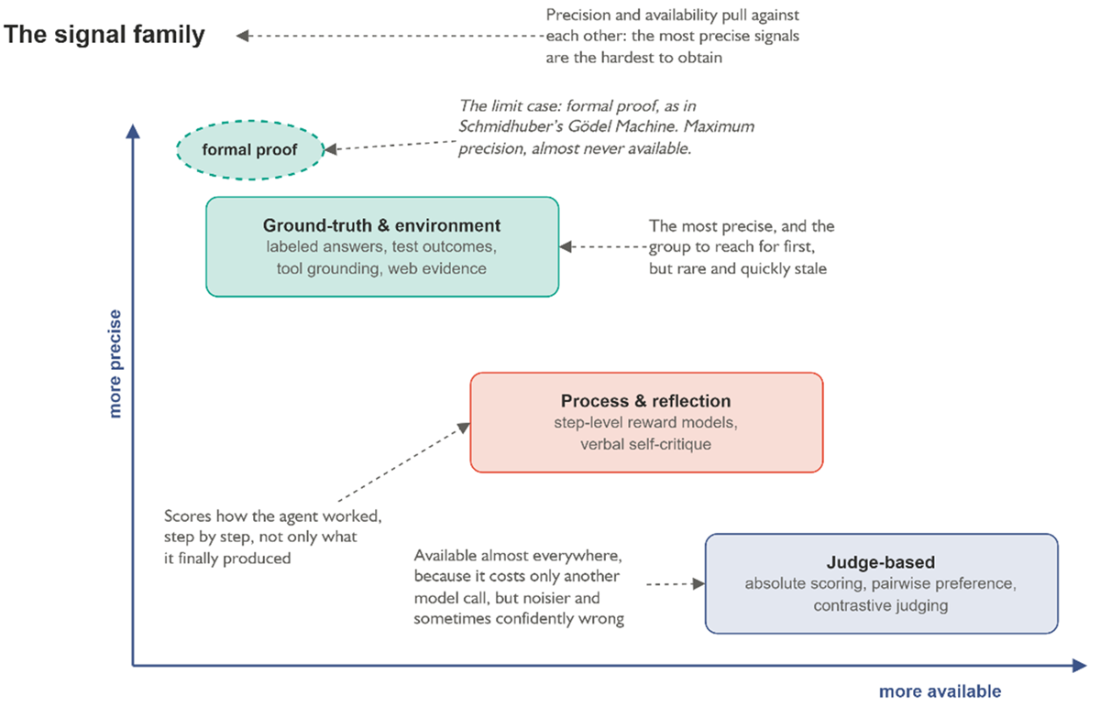
Figure 1.9 The signal family arranged by precision against availability. Ground-truth and environment signals are the most precise but the rarest; judge-based signals are available almost everywhere but are noisier, and process and reflection signals assess how the agent worked rather than only what it produced.
See how process and reflection signals assess an agent’s work, alongside signals that score its output. section 1.4.1