liveBook · Manning

Process supervision

As explained in Designing AI Agents

Process supervision evaluates intermediate steps in a problem-solving process rather than assessing only its final answer.

Process supervision checks intermediate problem-solving steps instead of judging only the final answer. It adds a separate verification path, but does not make generated reasoning a faithful record of hidden computation or replace domain evidence. section 5.2.1

Lightman et al. found it stronger than outcome supervision in MATH experiments and released roughly 800,000 human step-level labels. Measure its cost and value on the target workload rather than assuming universal gains. section 5.2.1

Figure 5.2 Three ways to externalize intermediate reasoning. None should be confused with a guaranteed export of the model's private reasoning.
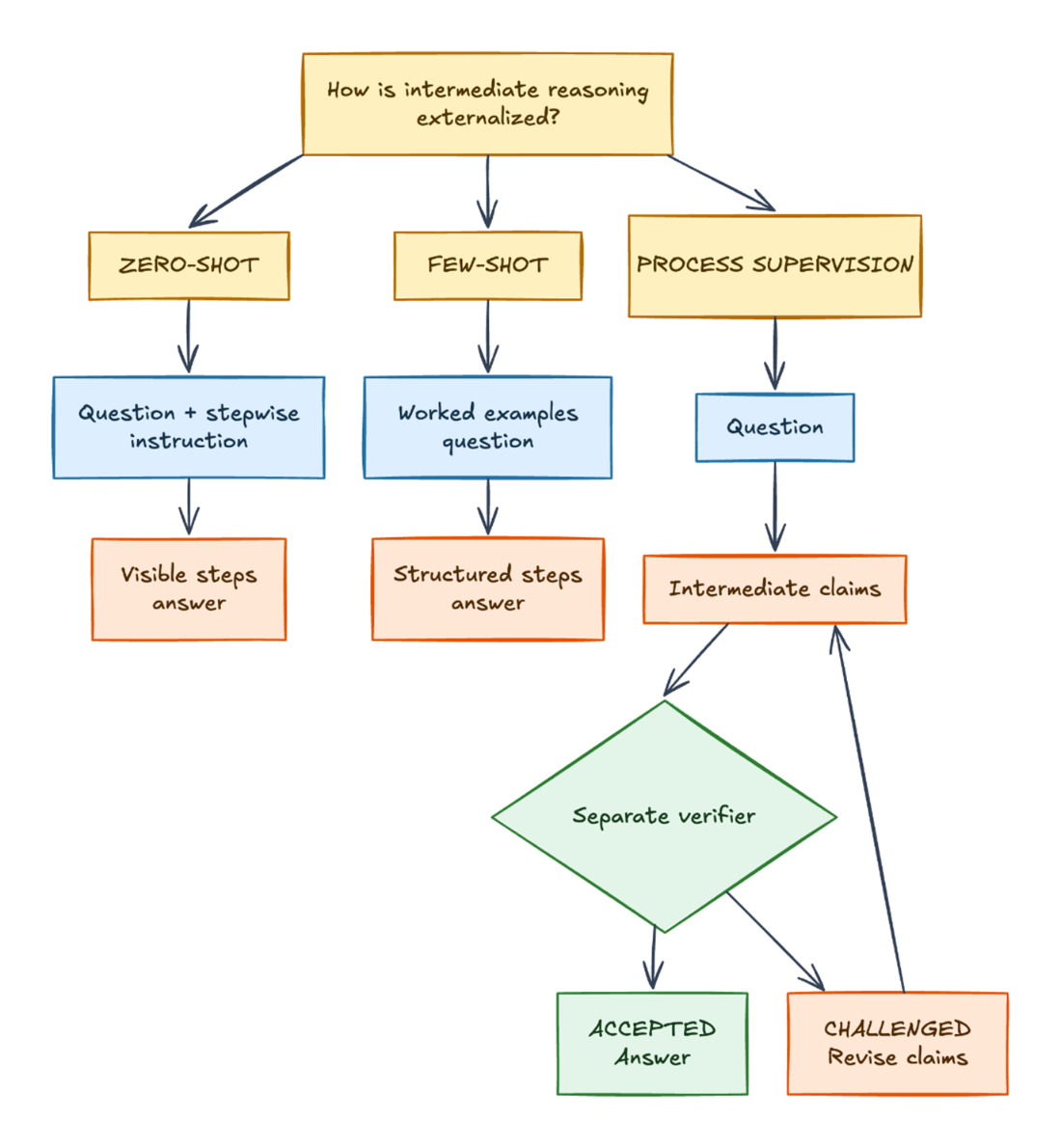
Compare zero-shot prompting, few-shot prompting, and process supervision as ways to handle intermediate reasoning. section 5.2.1


How Designing AI Agents covers it

How deep it goes
Compares step-level checks with final-answer evaluation and reports MATH results, while leaving workload-specific costs to measurement.
Examples
Uses MATH experiments and roughly 800,000 human step-level labels as concrete evidence.
What you can do after
Evaluate intermediate steps separately from final answers and measure the approach on a target workload.
How it connects
Connects chain-of-thought prompting with outcome supervision through contrasts among reasoning variants.

Also explained in

Compare how 2 books explain process supervision →

Related concepts

This explainer was generated by Manning's knowledge graph from the text of Designing AI Agents. The section links point to the parts of the book it draws on.