A product bet is the specific choice that makes a product worth building: who it serves, what it excludes, and how it delivers value. State it as “It’s X, but Y,” using a familiar product as the anchor and the difference as the strategic bet. section 5.3
Cal.com’s bet
“It’s Calendly, but free and open-source, and built to disappear inside other companies’ apps.” This points to developers embedding scheduling—not solo users—as the real customer. The hideBranding toggle and packages/embeds/ directory make that bet visible in the implementation. section 5.3
Use a product bet to interrogate an unfamiliar repository:
- Find the familiar product that supplies the “X” anchor. section 5.3
- Name the “Y”: business model, technical method, distribution channel, or deliberate exclusion. section 5.3
- Infer the ideal customer profile from the repository’s most complex surfaces. section 5.3
Figure 5.4 A vague pitch like "We transform the relationship between individuals and information" conveys nothing, while a concrete one-liner like "Calendly, but open-source and embeddable" lets you picture the product immediately.
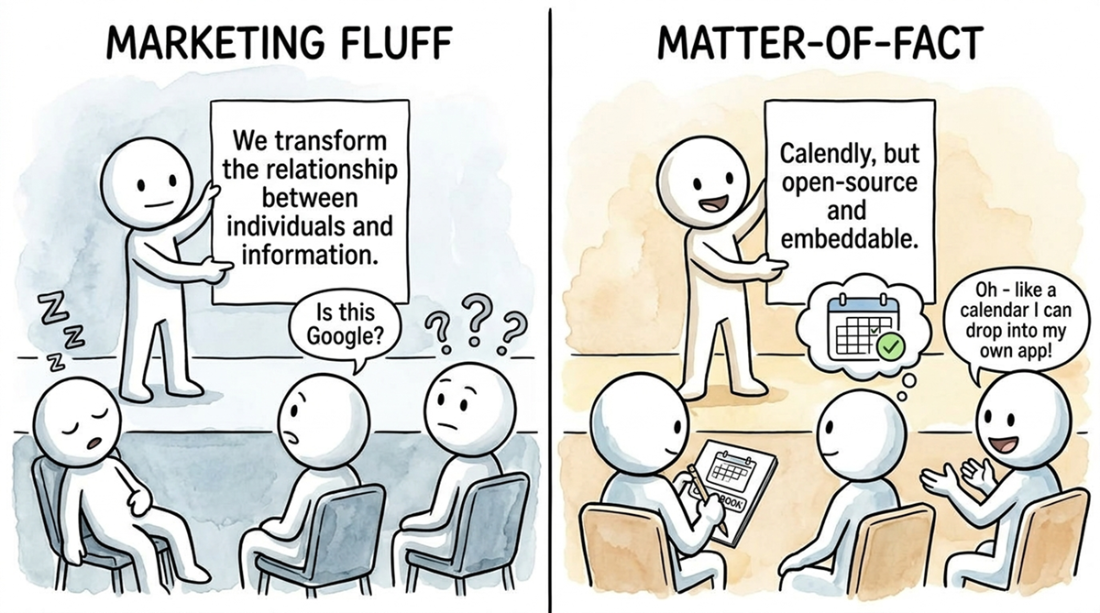
Compare vague promotional language with a concrete product bet that makes the product and its differentiation immediately sketchable. section 5.3
