Productionization turns a deep learning model into a product ready for users. It follows research and prototyping in the development cycle and prepares a model to serve real requests, sustain expected load, and handle adverse conditions rather than remain in an interactive notebook environment. section 10.0 section 10.2
Figure 10.2 Three major stages in a sample path to production. Research and prototyping go through many iterations before productionization.
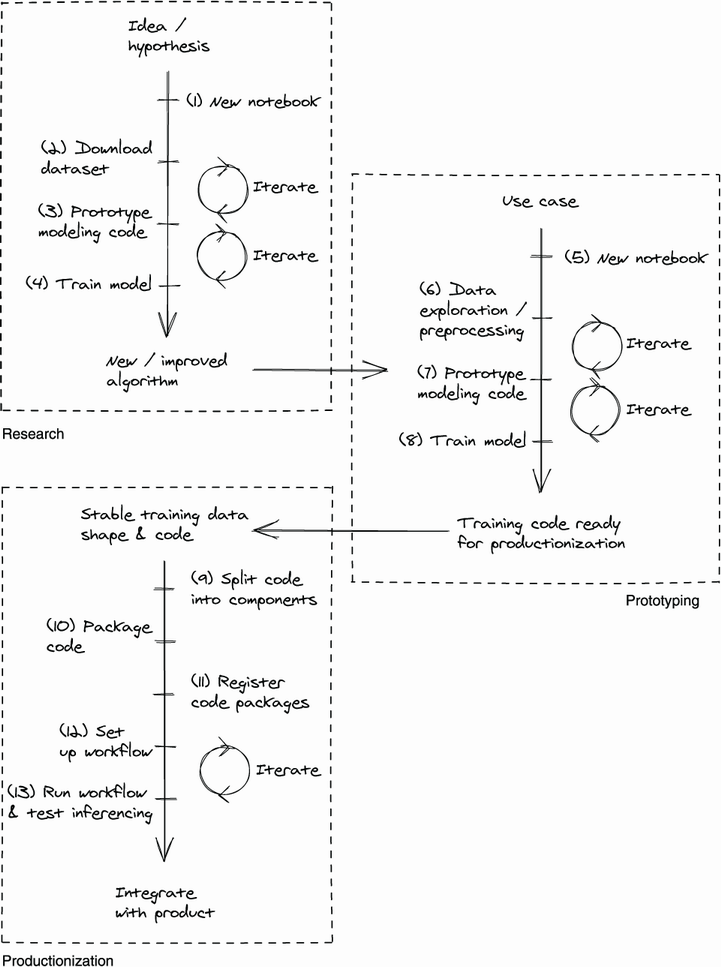
The path to production places productionization after iterative research and prototyping, showing the transition from an evaluated approach to a released product. section 10.0
A production-ready model needs an operational contract and a repeatable handoff:
- Serve inference requests from an end product or end users while meeting a predefined service-level agreement, such as latency or availability targets. section 10.2
- Make production problems easy to troubleshoot as the model encounters malformed input, request overload, and other harsh operating conditions. section 10.0 section 10.2
- Package stable training code, inference code, and source models so system services can train, track, and serve models consistently. section 10.4
- Integrate satisfactory inference with the end-user product, using a deployment strategy when serving cannot be interrupted. section 10.4
Productionization is also an infrastructure and collaboration problem. Data engineers, platform developers, and data scientists coordinate to move a project forward; a capable deep learning infrastructure reduces operational and communication overhead by automating model building and data processing. Its practical aim is to let data scientists set up pipelines, deploy models, and monitor production systems without becoming DevOps or data-engineering specialists. section 1.1.4 section 1.1.1
From stable workflow to uninterrupted service
After training data and code have stabilized, package the training and inference components. When the training workflow produces a satisfactory inference response, connect it to the user-facing product and choose a deployment strategy if requests must continue without interruption. section 10.4
