A profile curve describes how a rotational surface’s radius changes with height. Treating it as r(z) turns a two-dimensional curve into a three-dimensional surface of revolution. section 8.2.2
Build the surface by combining the profile with circular motion:
- Choose height samples and radius samples, then interpolate them with a polynomial. section 8.2.2
- For angle θ and height z, compute x = r(z) cos(θ), y = r(z) sin(θ), and retain z. section 8.2.2
- Map UV coordinates into θ = 2πu and z = zmaxv, producing coordinate arrays for a sampled mesh. section 8.2.2
A low-polygon mushroom
Radius samples that grow, bulge, shrink, grow again, and end at zero produce a mushroom-like profile. Perturbing radii and height generates varied mushroom meshes. section 8.2.2
Figure 8.14 The profile curve of a mushroom, showing how the mushroom radius changes as the z-coordinate rises
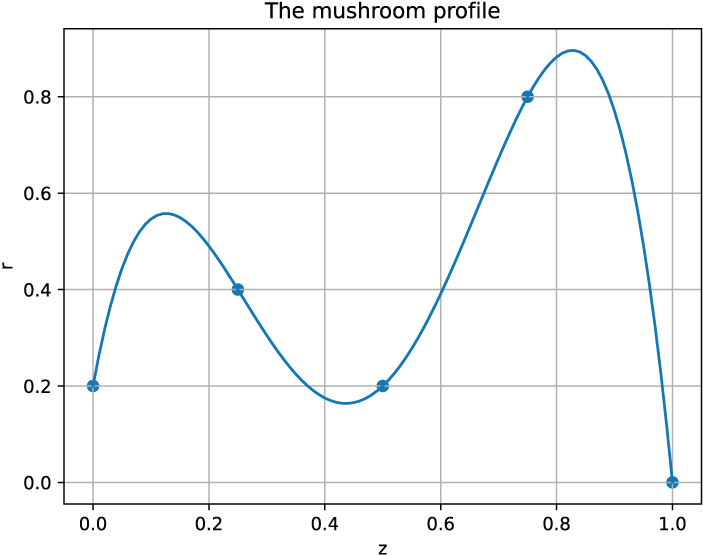
Use the profile-curve figure to see how radius changes along the z-coordinate before revolution creates the mushroom surface. section 8.2.2
