Progressive quantization reduces the training shock of quantization-aware training (QAT): instead of moving directly from FP32 to INT4, the model first trains with a finer grid, then steps down to the target precision. Weights can adapt to each grid before it becomes coarser. section 5.3.1
A typical schedule moves from INT8 to INT6 to INT4. Coordinate each bit-width transition with the learning-rate schedule and observer state; loss may spike when precision drops, then recover as training continues. Fold batch normalization before QAT so quantization parameters match the weights used at deployment. section 5.3.2 section 5.3.1
Twenty-epoch schedule
On SmallCNN, a schedule stepped from INT8 to INT6 at epoch 6 and INT4 at epoch 11. Loss rose from 0.0498 to 0.0844 at the INT4 transition, then recovered; validation accuracy reached 90.30% against a 90.00% FP32 baseline. section 5.3.2
Figure 5.10 The complete QAT schedule coordinates four components. Bit-width decreases progressively (INT8→INT6→INT4). The learning rate warms up during INT8 calibration, then cosine-decays through the remaining phases. Observers freeze at epoch 8, after they've seen the INT6 distribution. Batch normalization is folded before training begins.
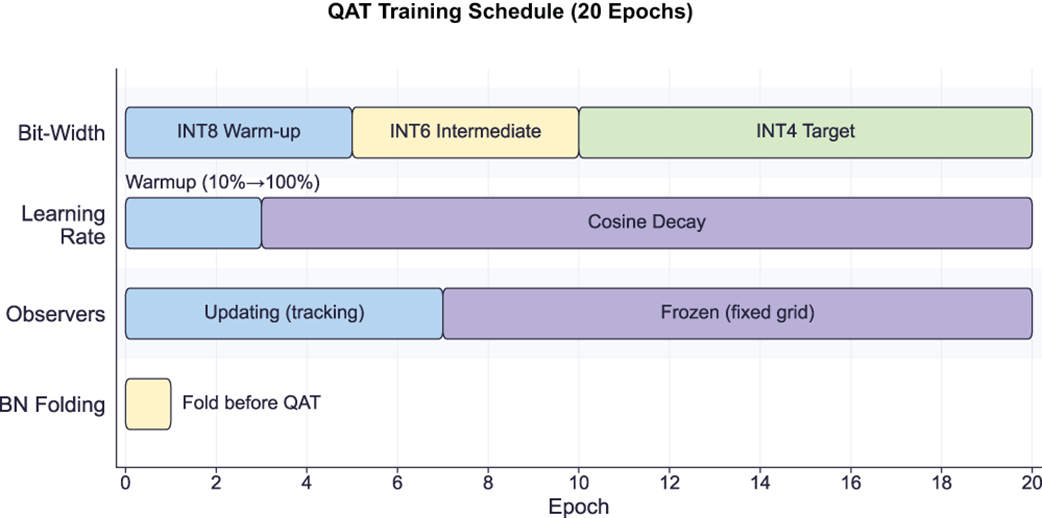
Use the schedule diagram to see how bit-width, learning rate, observer freezing, and batch-normalization folding fit together. section 5.3.2
