Project duration is the total time required to complete a project. In a dependency network, it is calculated by summing expected activity times along the longest path, identified as the critical path. section 13.3.1
Estimate and interpret project duration by:
- Using a forward pass to calculate each activity’s earliest start and finish times. section 13.3.1
- Summing expected times on the longest path to obtain the project duration. section 13.3.1
- Combining critical-path variances, assuming independent activity times, to estimate uncertainty around the duration. section 13.4
- Comparing a due date with the mean duration through a standard deviation and z-score under a normal distribution. section 13.4
Automated reporting tool
The network analysis estimates a 29-week project duration. With a 30-week due date and a 1.41-week standard deviation, the z-score is 0.709. The supplied z-table interpretation gives a 78.52% completion probability; the SciPy example prints 76.09%. section 13.3.1 section 13.4
Figure 13.2 A visual representation of the automated reporting tool project plan, where each activity is represented by its unique identifier. Lines and arrows between activities represent dependencies. The sequence of digits immediately beneath each activity represents, in order, the activity’s earliest start time, expected duration, and earliest finish time. The earliest times are derived by using a forward pass through the network. Based on this analysis, the project timeline is 29 weeks, which is the length of the longest path in the network.
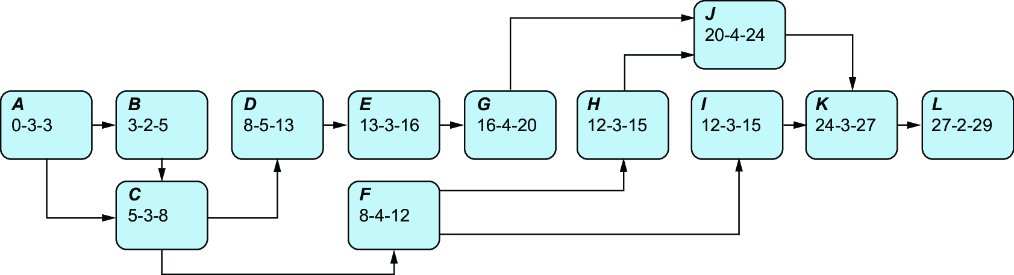
Visualizes activity dependencies, expected durations, earliest times, and the 29-week longest path. section 13.3.1
